


You’ve started reading.We’ll track how long you spend with this article.
When you reach the end, we’ll show how much money you would win if you were awarded $1 billion for every second you spend on this page.Elon Musk, worth $696 billion as of Wednesday, is poised to become the world’s first trillionaire when SpaceX goes public Friday.
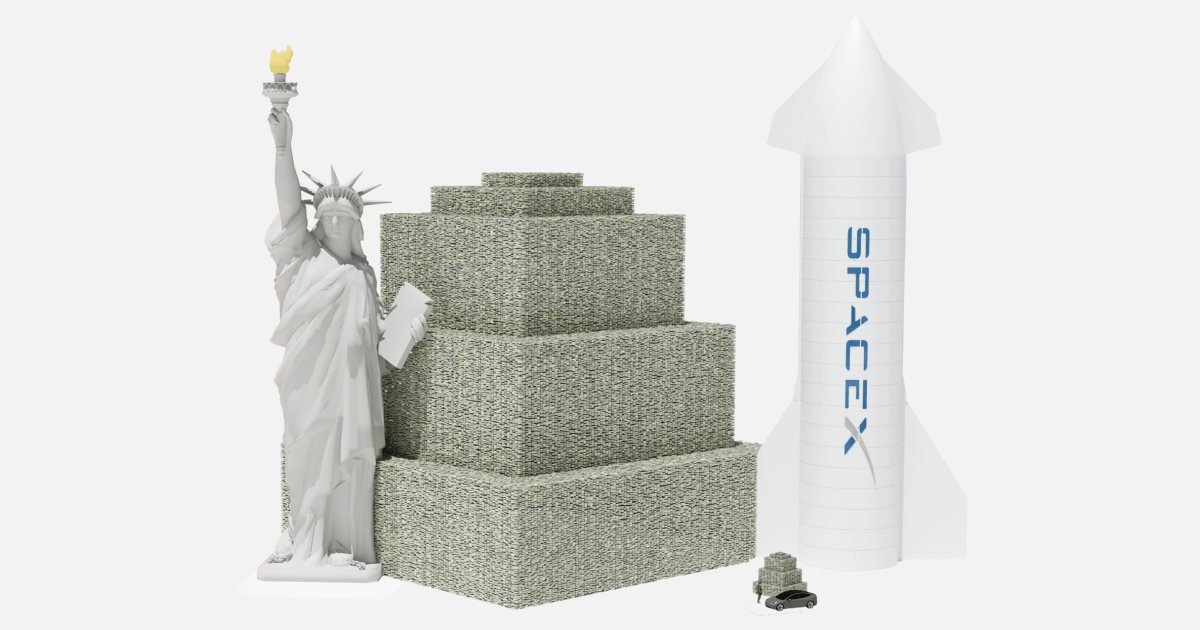
But what does 1 trillion actually mean? Here’s how to think about its immensity and the power it represents.Subscribe to read this story ad-free Get unlimited access to ad-free articles and exclusive content.SpaceX’s projected IPO valuation of $1.77 trillion is nearly 10 times that of Alibaba’s in 2014, which is still the highest ever recorded in the U.S.While SpaceX may stand out against historical benchmarks, the rapid growth of AI rivals OpenAI and Anthropic, each with a valuation hovering around $900 billion, suggests that a trillion dollars could become a new standard.Numbers of this scale are rare in everyday life.Google tracks word usage across millions of books and its data shows that references to “trillion” remained scarce for much of the 19th and early 20th centuries before increasing after World War II.“Up until relatively recently, we had no real reason to talk about such numbers,” said John Allen Paulos, a professor emeritus of mathematics at Temple University.
“So it’s not surprising that they don’t make much sense to people.”In his 1988 book “Innumeracy,” Paulos argues that humans are especially bad at reasoning when it comes to very large numbers.Part of the difficulty stems from our inability to intuitively grasp exponential growth.
As a result, figures like 1 billion (1,000,000,000) and 1 trillion (1,000,000,000,000) can feel deceptively close.In reality, the gap is enormous: 1 trillion equals 1,000 billion.To help visualize such enormity, Paulos recommended a time scale: 1 million seconds in the past is less than two weeks ago, but a billion seconds puts us in 1994, ...