


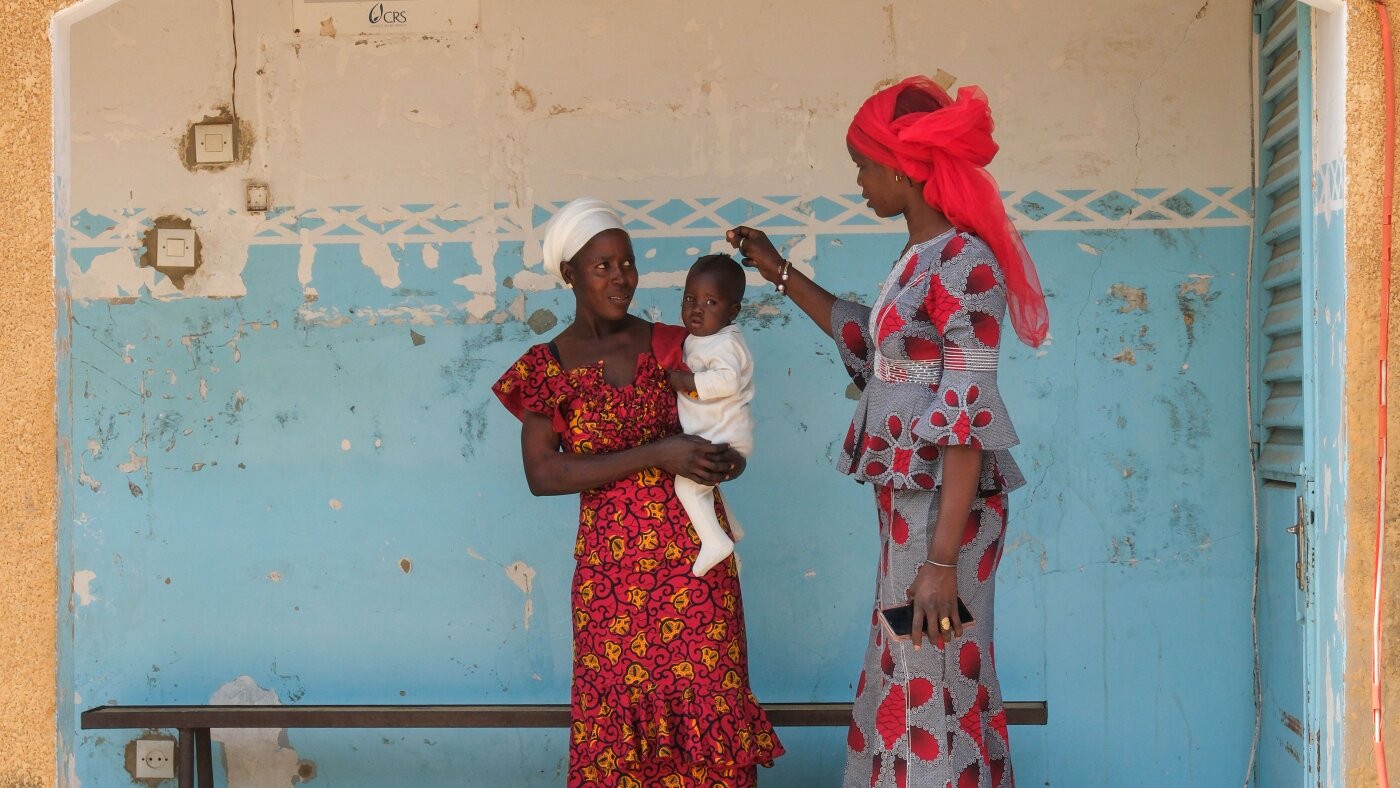
Adama Faye (right), a community health worker, weighs the son of Ndiolle Diouf at the health clinic in the village of Keur Mbar to determine if he is malnourished.Ricci Shryock for NPR hide caption Yacine Lo's twins were clearly not well.Diarra and Khadim, her girl and boy, should have been busily toddling around like almost-2-year-olds they were.
Instead "they were very, very weak," she says."It's very sad to see your kids that way.
When my kids aren't well, I can't be well, I can't even eat."Lo lives outside of Keur Mbar, a small rural community in western Senegal with high levels of poverty.As a result, malnutrition is common here, she says, and she knew the signs.
She also knew where to go for help. So she wrapped Diarra and Khadim on her back, and set off on foot to a clinic over 3 miles away.The route is flat but harsh.
The vast, dusty landscape is only broken by the occasional acacia tree or the looming contortions of a baobab, which looks as though it grows by moonlight."It takes long," she says."It's really very painful with your babies on your back under the hot sun."Initially, the journey was worth it.At the clinic, community health workers confirmed her suspicion and gave her a week's supply of a near-miracle food — Plumpy'Nut, the brand name of what's called a ready-to-use therapeutic food, or RUTF.
It's a nutrient-dense paste made up of peanut butter, powdered milk, oil and sugar, fortified with vitamins and minerals.Typically, in Senegal and other countries, a parent from a remote area would have had to travel even further to find a hospital or doctor who could provide this life-saving food.But for the past few years, Senegal, with the help of U.S.
funding and nonprofit organizations, has been trying to bring care closer to kids like Diarra and Khadim.Once a week, she'd make the journey back to the clinic for more Plum...