


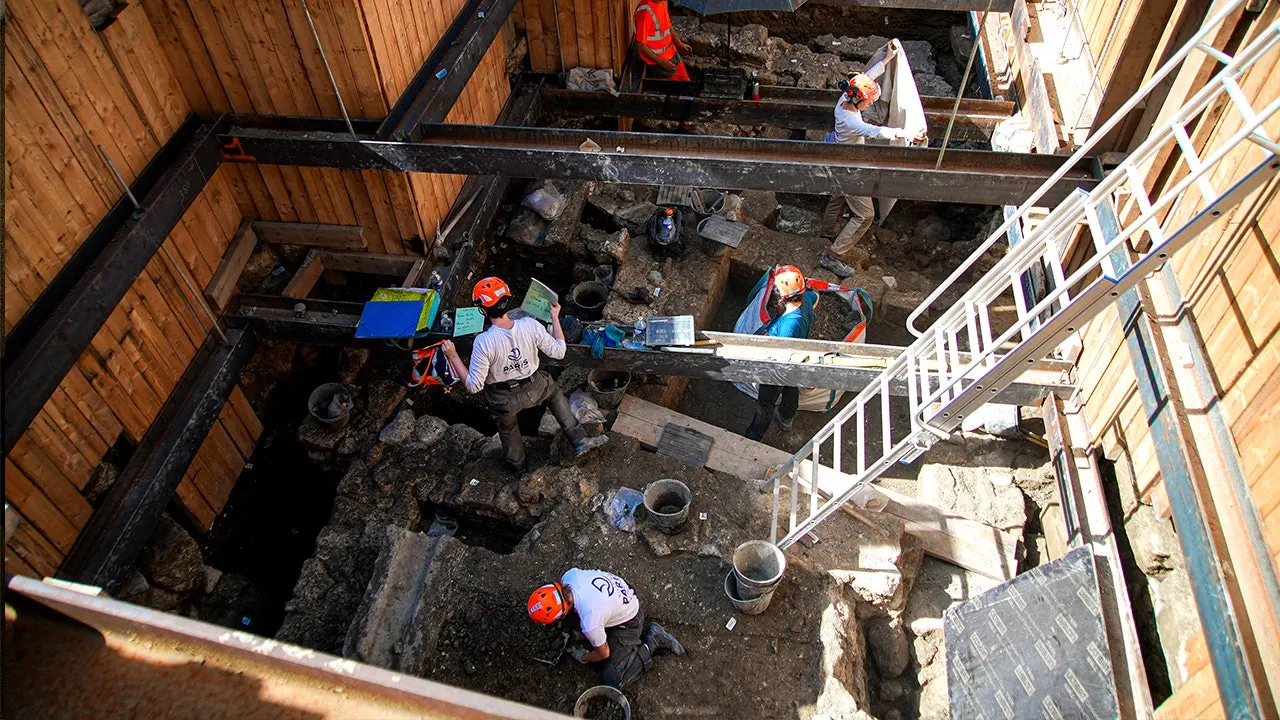
Archaeologists excavating Notre Dame cathedral in Paris have uncovered centuries of buried history, including a 1,700-year-old Roman coin and baffling markings that experts still can't explain.The excavation, which has been in the works for years, began after the cathedral was rebuilt in the wake of a devastating 2019 fire.The latest results were reported earlier in June by the Associated Press (AP). Digging in the cathedral's forecourt, archaeologists have searched roughly 13 feet below ground for remnants of the city's past.'HERMETICALLY SEALED' ROMAN SARCOPHAGUS FROZEN IN TIME FOR 1,700 YEARS FINALLY OPENED BY ARCHAEOLOGISTSAmong the finds are a 4th-century coin bearing the face of Emperor Constantine, as well as medieval pottery fragments bearing markings archaeologists have not yet deciphered.One image shows a medieval pottery fragment recovered during the excavation, one of several ceramics unearthed beneath Notre Dame.A restoration project at Notre Dame Cathedral is uncovering evidence of daily life from centuries of Parisian history.
(AP Photo/Nicolas Garriga)Archaeologist Valentine Breloux told the AP it's "rare to find complete ceramics," adding that the most astonishing discoveries were mysterious reddish markings painted inside pottery fragments — which experts have yet to decipher.ANCIENT 'SEATED' SKELETONS UNEARTHED BENEATH MODERN SCHOOL SITE, PUZZLING ARCHAEOLOGISTSThe excavation, which French media has called the "dig of the century," has also yielded hundreds of other objects, including whole jugs and cups that were thrown into a latrine."It makes the city feel less like a postcard and more like something still being discovered."The latrine, which doubled as a garbage pit, also contained broken plates and animal bones.Archaeologists also uncovered medieval grain pits, which were used to preserve harvested grain, from the sixth to the 10th centuries.CLICK HERE TO SIGN UP FOR OUR LIFESTYLE NEWSLETTERA Roman-era doorstep was also discovered at the ...