


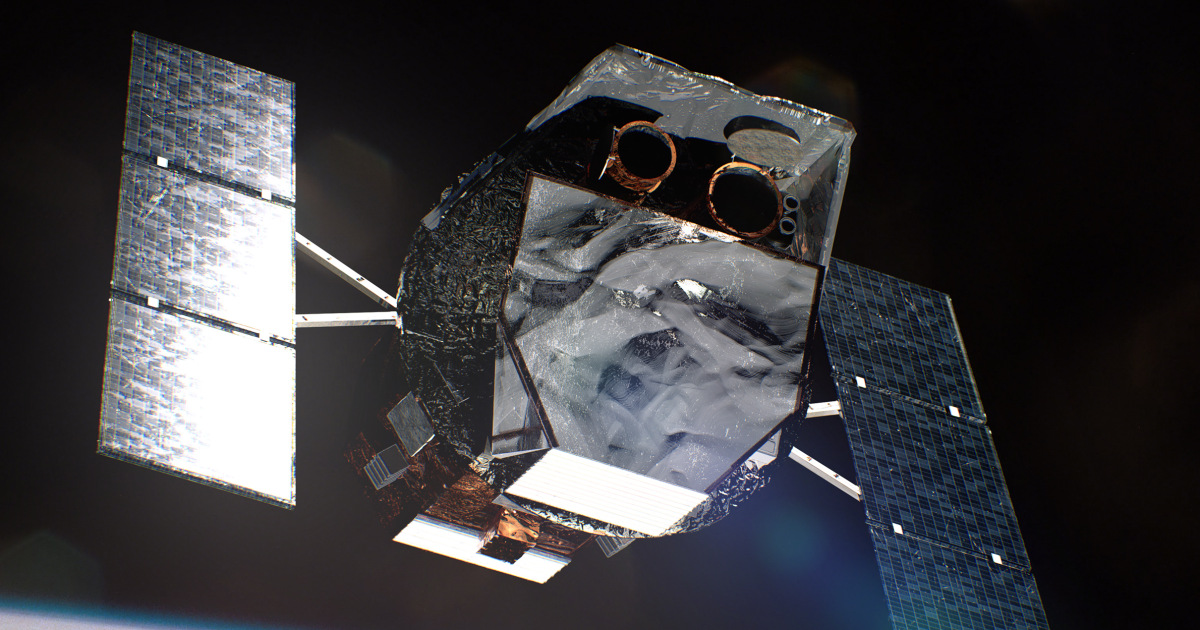
NASA on Tuesday plans to launch a mission to save one of its workhorse space telescopes.Limited time: Save 25% on NBC News subscriptionGet exclusive reporting, live Q&As and ad-free reading.For more than two decades, the agency’s Neil Gehrels Swift Observatory has been circling Earth studying gamma-ray bursts, the most powerful explosions in the universe, which are triggered by events like births of black holes and collisions between ultra-dense stars at the ends of their lives.But Swift is at imminent risk of sinking back into the atmosphere, where it would break apart upon re-entry.
NASA’s prediction models suggest that the telescope’s orbit could drop to an altitude considered critically low — below 185 miles — in October.“It is a swift observatory that can quickly pivot across the night sky to find things that go boom in the night,” Dr.Shawn Domagal-Goldman, director of NASA’s astrophysics division, said during a news conference on June 17, pausing to emphasize the pun with Swift’s name.
“So we decided, yeah, we want to go save this one this time because of how special it is.” To stave off the observatory’s demise, NASA plans to launch a robotic spacecraft to boost Swift’s orbital path.The agency last year awarded a $30 million contract to the Arizona-based company Katalyst Space Technologies to build the spacecraft, with aerospace giant Northrop Grumman providing the plane and rocket that will send it into orbit.
The plan calls for Northrop Grumman’s Stargazer airplane to take off from the Marshall Islands no earlier than Tuesday at 6:23 a.m.Once it reaches 40,000 feet, the aircraft is expected to deploy the company’s Pegasus XL rocket, carrying the 6-foot, 880-pound robotic spacecraft called LINK.
The rocket should then launch LINK into orbit, where it would attempt to capture the Swift observatory and raise its orbit over a period of several months.All satellites in low-Earth orbit slowly lose altitude as they experience...