


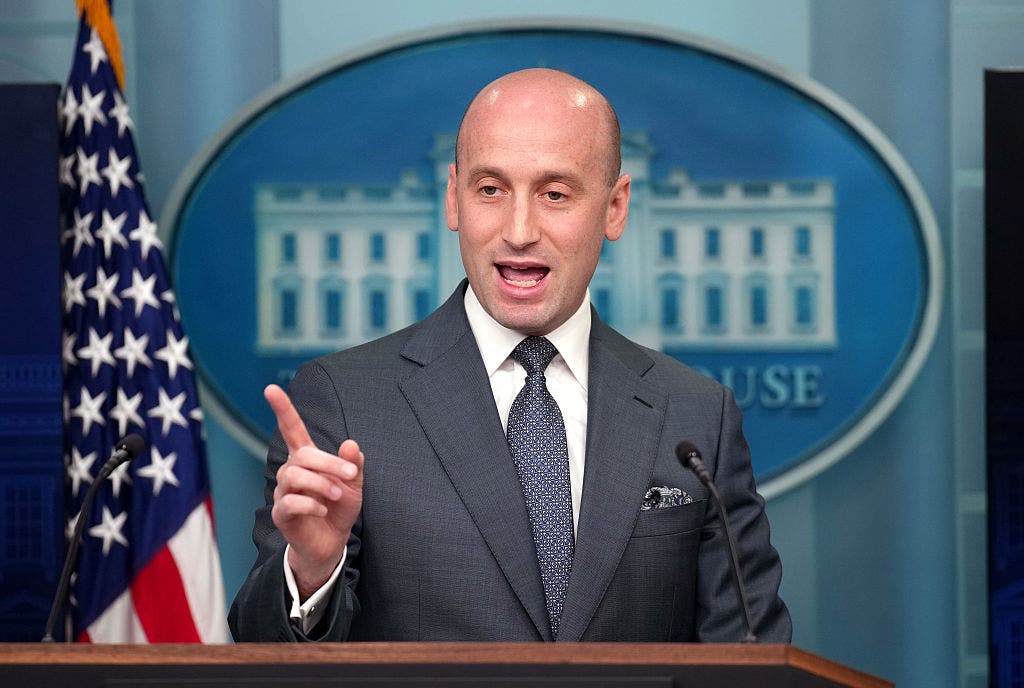
White House Deputy Chief of Staff for Policy Stephen Miller called out Supreme Court Justices Amy Coney Barrett and John Roberts Monday, accusing the two of "cav[ing] to the radical left" by ruling in favor of a Mississippi law allowing mail-in ballots to be counted even if they are received after Election Day. "Justice Roberts and Justice Barrett decided to cave to the radical left.[Justice] Alito was so clear in his wording about what Election Day means.
Nobody could read the statute, could read that opinion, could read what Alito wrote and come to any other conclusion," he told "The Ingraham Angle.""It's Election Day, not election week, not election month, not election months.So this was really a travesty, and it underscores why we have to keep fighting to pass the SAVE America Act."SUPREME COURT RULES ON MAIL-IN BALLOTS RECEIVED AFTER ELECTION DAYWhite House Deputy Chief of Staff Stephen Miller speaks the daily press briefing in the Brady Press Briefing Room at the White House on May 1, 2025, in Washington, D.C.
(Photo by Andrew Harnik/Getty Images)Miller's remarks came after Roberts and Barrett sided with liberal justices in a 5-4 ruling Monday, holding that Election Day, in the context of federal law, set a deadline for when voters must make a choice regarding their preferred candidate but said that relevant laws have no standard for when ballots must be received to be considered valid. Trump-appointed Barrett authored the majority opinion ruling in favor of the law.She was joined by Chief Justice John Roberts, as well as Justices Sonia Sotomayor, Elena Kagan and Ketanji Brown Jackson.TRUMP'S SAVE AMERICA ACT SHOWS SIGNS OF LIFE IN THE SENATE DESPITE REPUBLICAN REVOLTSpring flowers bloom outside the U.S.
Supreme Court building as oral arguments are heard at the Supreme Court in Washington, D.C., on Mar.30.
(REUTERS/Evelyn Hockstein/File Photo)Justice Samuel Alito penned the dissent, warning the decision could erode already-fragile trust among many in t...