


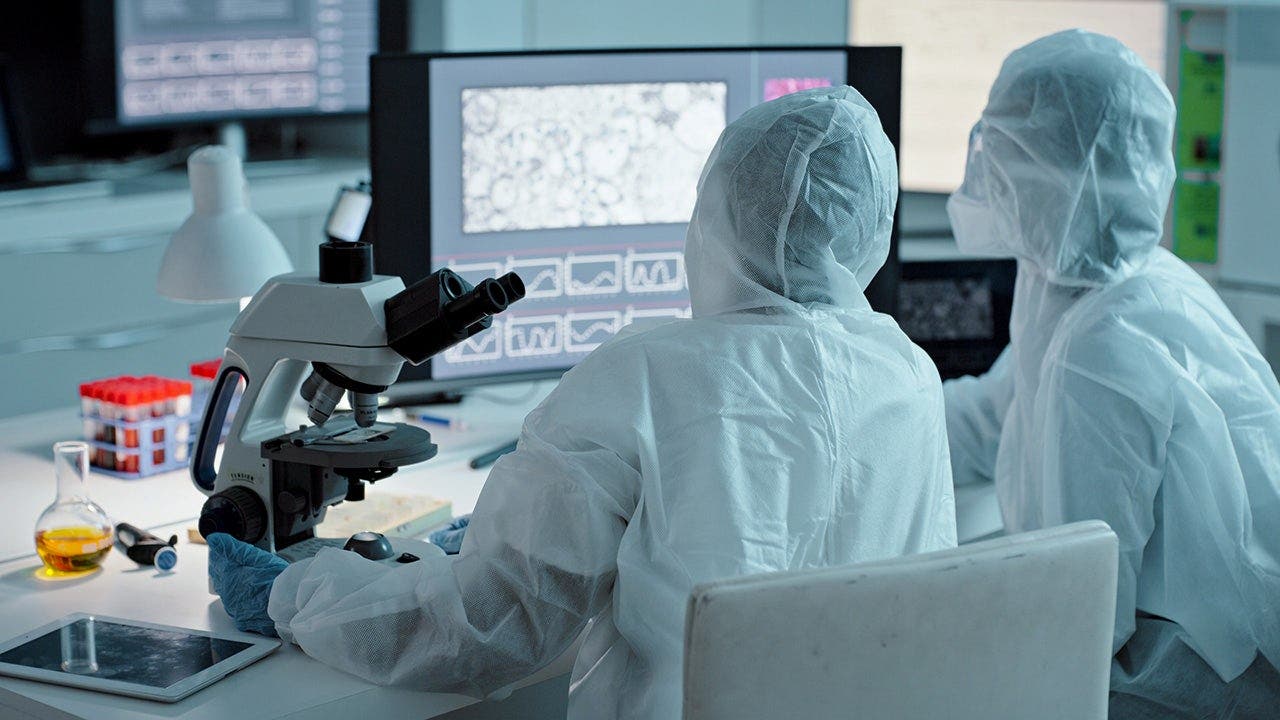
Scientists at the University of Minnesota say they have built the most life-like synthetic cell yet, creating a laboratory-made system assembled entirely from nonliving components that can grow, replicate its genetic material, divide and even pass beneficial traits to future generations.The researchers describe the work as a major step toward building artificial life, but said the synthetic cells cannot survive outside carefully controlled laboratory conditions and require externally supplied nutrients and specialized components to grow and divide.Their findings were published Thursday as a preprint on bioRxiv, meaning the research has not yet undergone peer review.SCIENTISTS UNVEIL 'LIVING BANDAGE' THAT COULD DRAMATICALLY SPEED WOUND HEALINGScientists work in a laboratory in this file photo.Researchers at the University of Minnesota say they have developed a synthetic cell assembled from nonliving components that can grow, replicate its DNA and divide under laboratory conditions.
(iStock)"One of the most ambitious and fascinating goals of bioengineering is to build a biochemical system that could cross the threshold from chemistry to life," the researchers wrote.They said the work demonstrates "the first minimal cell with a cell cycle, genetically encoded growth and division, all coupled to selection and competition."The researchers call the synthetic cell "SpudCell." Unlike earlier approaches that started with living organisms, SpudCell was assembled from chemically defined, nonliving components.Its 90,000-base-pair genome enables the synthetic cell to produce proteins, replicate its DNA, feed, grow and divide into daughter cells.AI-DESIGNED 'UNIVERSAL VACCINE' PASSES FIRST HUMAN CLINICAL TRIAL, COULD PREVENT FUTURE PANDEMICSResearchers also introduced a genetic mutation that allowed some synthetic cells to grow faster than others.
After several generations, those faster-growing cells produced more offspring and became increasingly common in the population, demo...