


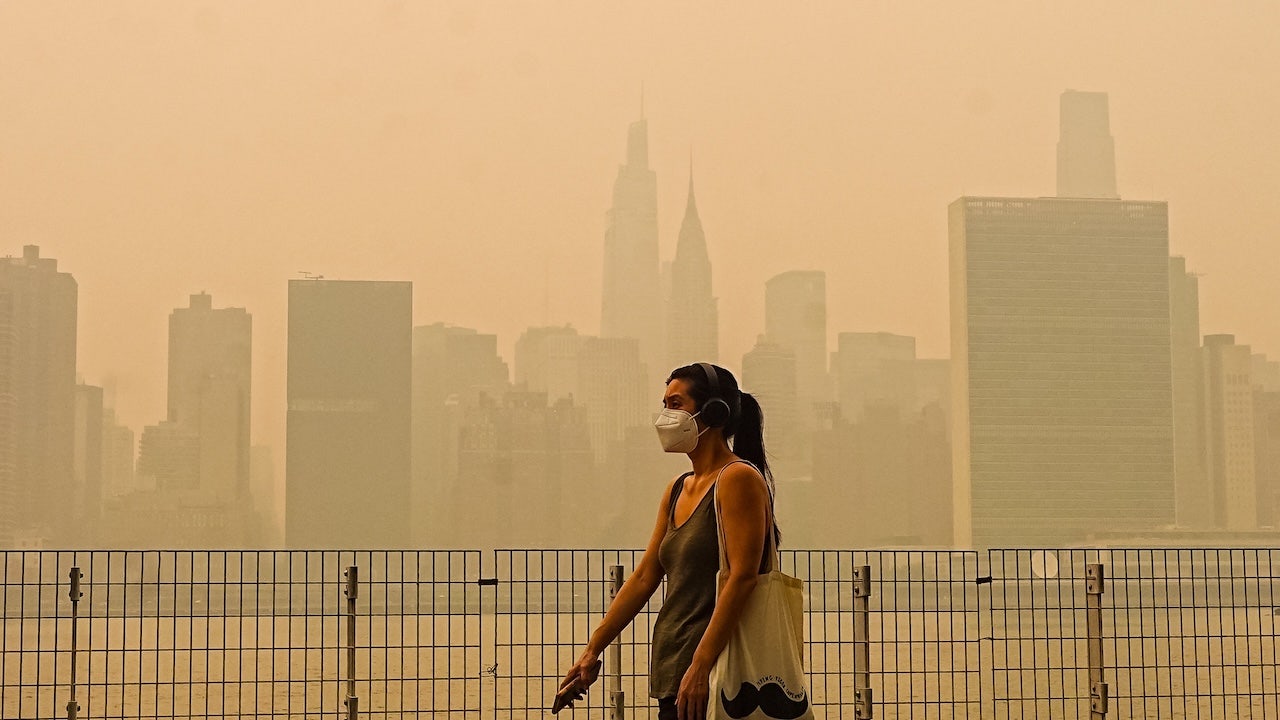
Canadian wildfire smoke is drifting across parts of the U.S., prompting doctors to warn that even healthy people may face risks from prolonged exposure to polluted air.More than 180 wildfires are burning in Ontario alone, while nearly 850 are active across Canada, sending smoke into the Midwest and Northeast, according to NASA.More than 20 states have been affected, prompting widespread air quality alerts from the Upper Midwest to the East Coast.DOCTORS WARN YOUR 'STOMACH BUG' MAY ACTUALLY BE A PARASITE THAT'S HARDER TO DETECTThe greatest concern comes from fine particulate matter (PM2.5), which is about 30 times smaller than the width of a human hair.According to the U.S.
Environmental Protection Agency (EPA), these microscopic particles can penetrate deep into the lungs and even enter the bloodstream.Smoke from massive wildfires in Canada engulfed the New York City skyline, reducing visibility and casting an orange haze on July 16.(Getty Images)"The main concern is fine particle pollution, known as PM2.5," Dr.
Fernando Safdie, director of endoluminal and airway surgery and a lung cancer specialist in Miami Beach, Florida, told Fox News Digital."These particles are small enough to get deep into the lungs, and the smallest can pass into the bloodstream.""Smoke also carries irritant gases," he added.
"That combination is what triggers symptoms."IS LETTUCE STILL SAFE TO EAT AMID TACO BELL ILLNESS PROBE? DOCTORS ANSWERThe EPA considers an Air Quality Index (AQI) above 100 unhealthy for sensitive groups, while levels above 150 are unhealthy for everyone.The most common effect of wildfire smoke is irritation to the respiratory system."Most people notice burning or watery eyes, scratchy throat, runny nose or coughing," said Safdie."It can progress to chest tightness, shortness of breath, wheezing, headaches, fatigue and a faster heartbeat."Smoke from wildfires pours eastward over Canada and the U.S.in an image captured on the afternoon of July 14, 2026, by the VIIRS�...