


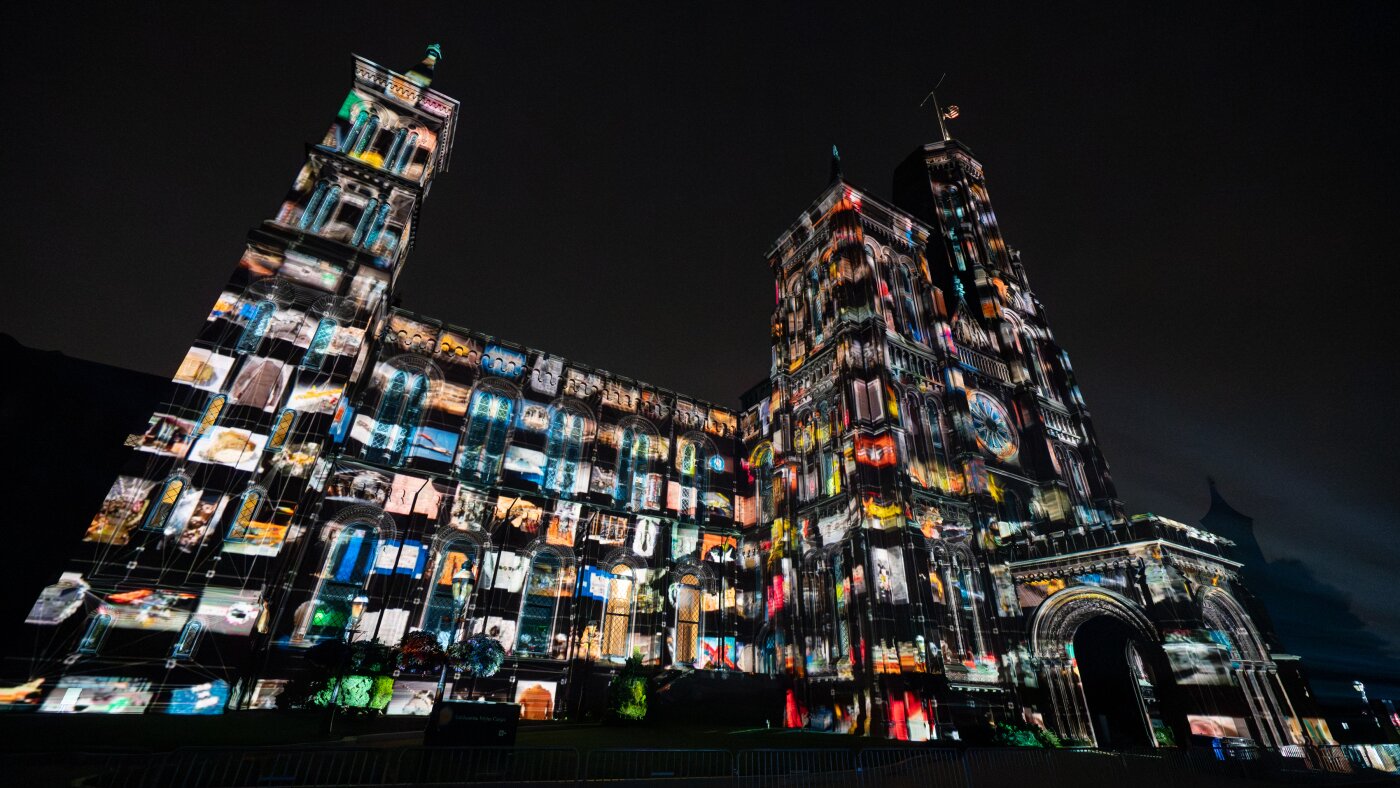
"What is beyond reality?" asks artist Refik Anadol.His latest projects include Dataland, an immersive art museum in Los Angeles, shown above, and an installation at the Smithsonian in Washington, D.C.
Refik Anadol Studio on behalf of Dataland hide caption Visiting the new Dataland museum in downtown Los Angeles is like stepping into a hyperreal nighttime fantasy.At various points as visitors move through black, cavernous spaces, they hear the sounds of Amazon rainforest creatures, a tropical thunderstorm, and excerpts from a Los Angeles Philharmonic recording of Mahler's Symphony No.3.In one room they see what a hummingbird would see as it flies through a dense, vividly-colored landscape.
In another, they stand before a massive, three-dimensional painting where bright, abstract shapes splash out of the frame in a real-time response to biometric data captured via wearable wristbands – kind of like fitness trackers.The museum also has a smell and taste component.
It's sensory overload.No two visitors' experiences of Dataland, which opened in June, are exactly alike.But they all stem from the singular creative mind of Refik Anadol.The digital artist behind what he calls "the world's first museum of AI arts" has spent a decade using AI algorithms to transform massive troves of data into bombastic, three-dimensional installations of light and sound.To create the immersive art at Dataland, the artist fed images and sounds from museum archives, labs and even his own travels to the Brazilian Amazon into a custom AI model.
He then directed that model to create specific scenarios, such as the dream-like hummingbird narrative.He describes his work as a 50-50 collaboration between humans and machines."Every artist in their practice has their own heavy question," Anadol told NPR in a recent interview at the museum, which he co-founded with his partne...