


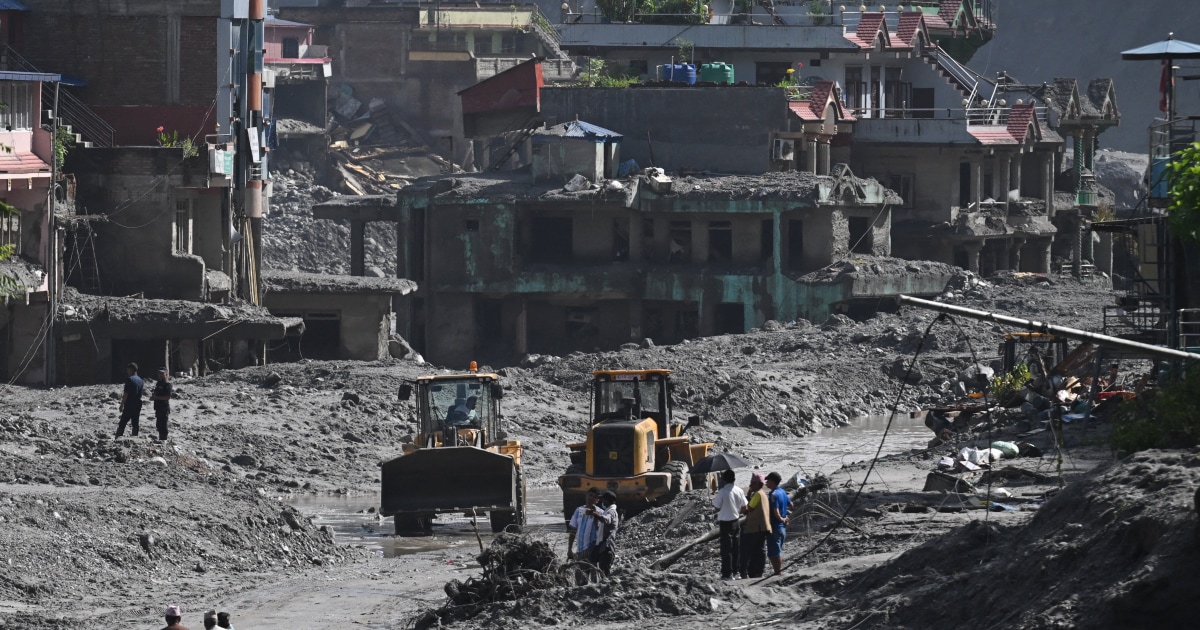
Authorities in Nepal have warned of further flooding after heavy rainfall, as China sheds more light on the scale of the disaster in its Tibet region.Five days after floodwaters unleashed by a glacier collapse buried communities under thick mud, rescuers in Nepal were still struggling to reach devastated areas as the full extent of the destruction came into focus.“The disaster here is overwhelming,” Ferrin Cole, an operations director with the U.S.-based Crisis Response International, told NBC News on Sunday.“The flood that came down that mountain just wiped out cities.
We’re going in as fast as we can to get people the help that they need.”About 100 Americans are among those missing across Nepal and China’s Tibet region, the State Department said Saturday.We know the severity of it, but still, you know, there’s a ray of hope for us to find our loved ones.Divya Chandrashekar, sister-in-law of american missing in nepalIn Nepal, the death toll has risen to 781, with more than 2,500 people still missing, including 592 foreign nationals, according to the country’s disaster agency.The Nepal Tourism Board said 289 foreign nationals have been rescued.China has separately reported 16 deaths and 546 people missing in the Tibet region, including 261 foreign nationals.
It remains unclear how much overlap exists between the Chinese and Nepali missing-person counts.NASA launches its next-generation space telescopeAdd to GoogleNASA launches its next-generation space telescope00:57NASA on Sunday launched a next-generation space telescope expected to survey hundreds of millions of stars and billions of galaxies, while helping unlock clues to dark energy, dark matter and some of the universe’s biggest mysteries.The Nancy Grace Roman Space Telescope lifted off at 7:26 a.m.ET from NASA’s Kennedy Space Center in Florida atop a SpaceX Falcon Heavy rocket.A SpaceX Falcon Heavy rocket with NASA’s Nancy Grace Roman Telescope on board launches from NASA’s Kennedy ...