


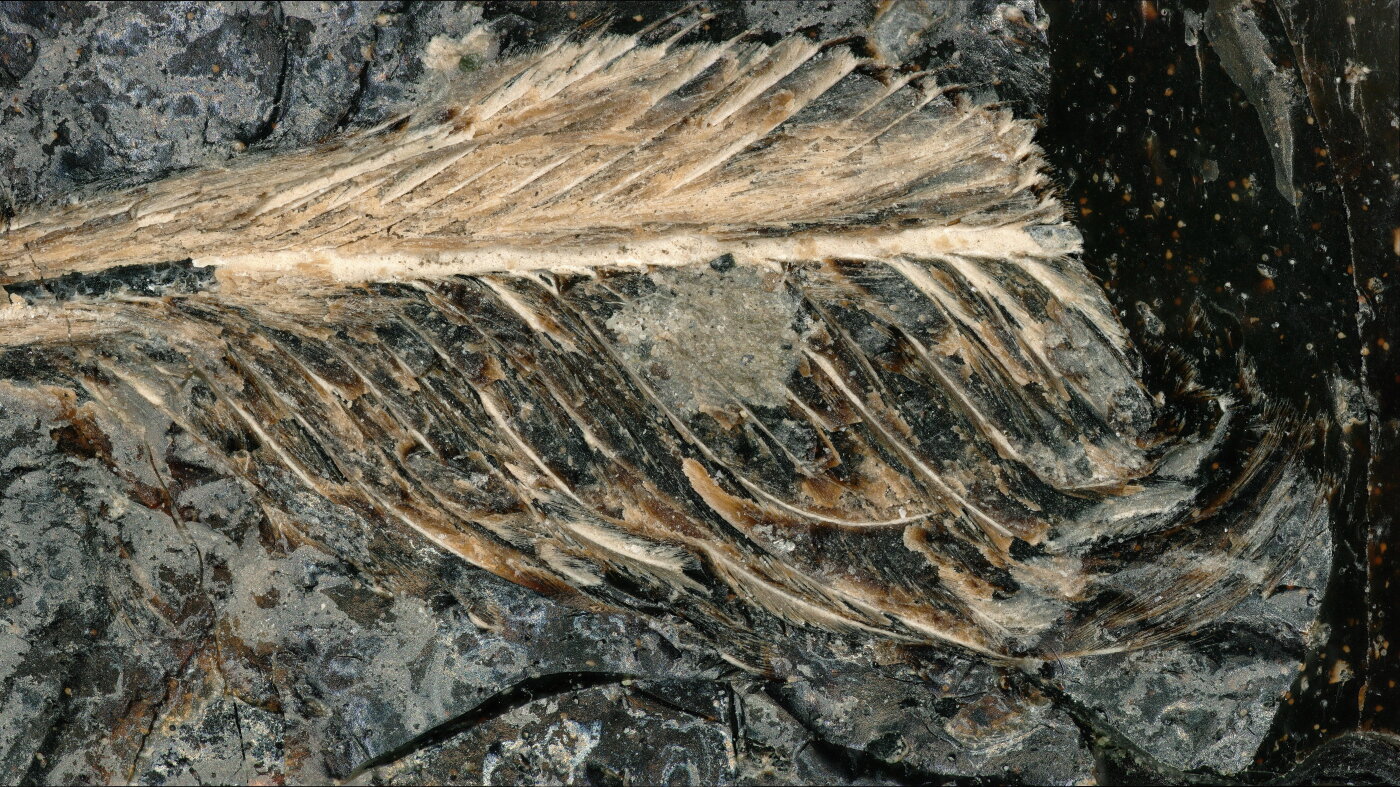
Paleontology can be quite physical.In 2016, David DeMar was doing field work in the rocky badlands of Montana in what's known as the Hell Creek Formation."We all get down on our hands and knees," he recalls."And I start crawling up the hill and I noticed this little dark, round object on the ground.
It was kind of odd."DeMar, the lab manager at the Burke Museum in Seattle, picked up the cherry-sized fossil.For new discoveries, everyday mysteries, and the science behind the headlines, follow NPR’s Short Wave podcast."I start looking at the surface of it," he says."And then I rolled it over and I was like, 'You got to be kidding me.'"Embedded in a small crack on the surface was a tiny fossilized branching structure.
As it turned out, this was the first fossilized feather from this part of the world.In addition, "it is, without a doubt, the best feather we've ever found from the age of dinosaurs," says Jingmai O'Connor, a bird expert and an associate curator of fossil reptiles at the Field Museum of Natural History in Chicago.The researchers say the plume, which they describe in the journal Current Biology, is part of a fossil assortment that may reveal part of a late Cretaceous food web from some 66 million years ago.And they speculate it could help explain why, around that time, many types of ancient birds died out alongside the dinosaurs after a giant asteroid collided with the Earth — while others survived to give rise to the birds we know today.
After first spotting the round nodule, DeMar quickly radioed his colleagues.At first, no one responded.
"They probably thought I was kidding," he says."But I got back on the walkie about five minutes later.I was like, 'No, hey guys, I think I found a bird feather.'"Subsequent analysis confirmed DeMar's conclusion.
The feather dates back to the late Cretaceous, right before the great extinction event that wiped out the dinosaurs and a large swath of other species.When O'Connor joined the project, very little was kn...