


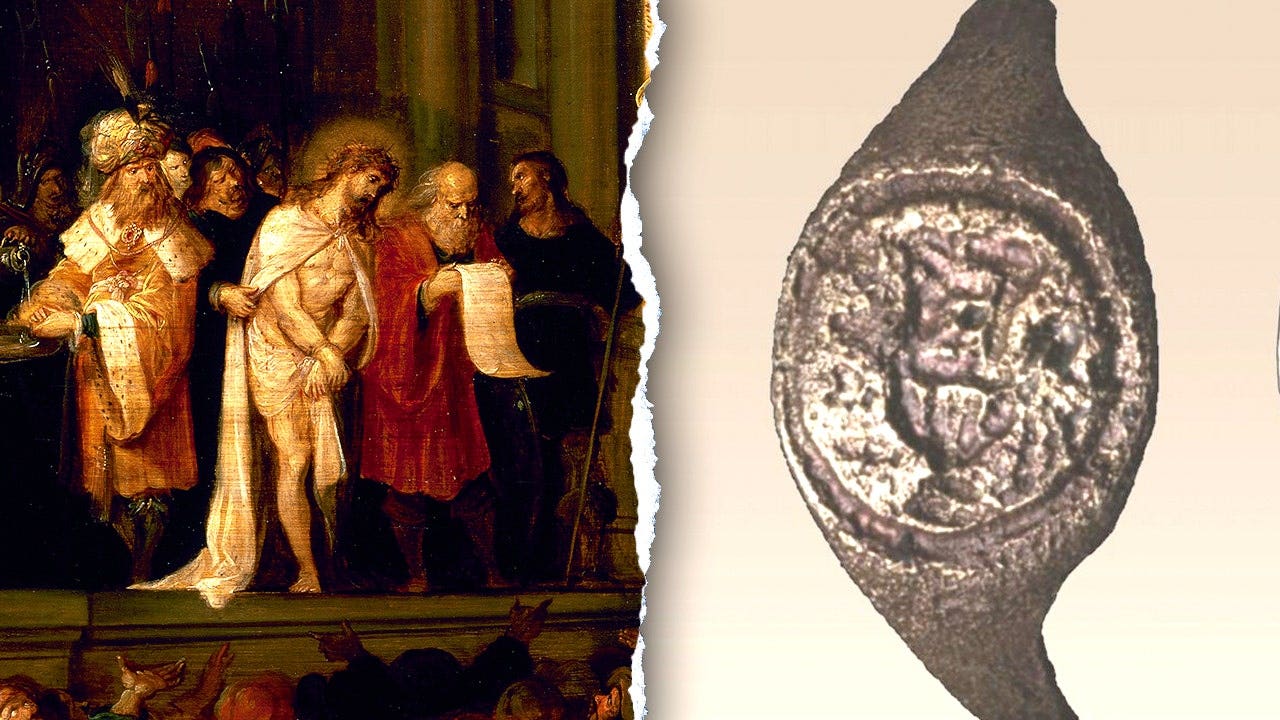
New research about an ancient ring bearing an inscription linked to Pontius Pilate may reveal fresh clues about how the Roman governor wielded authority — nearly 2,000 years after he sentenced Jesus Christ to death.The ring, discovered at Herodium, a mountaintop fortress in the Judean desert, in the 1960s, has long been known to archaeologists — but a new interpretation could help explain its connection to Pilate.The 2,000-year-old ring sat in storage for over 50 years before researchers published details about it in 2018, according to a release from the University of California, Los Angeles (UCLA).AUTHOR DINESH D'SOUZA CHALLENGES BIBLE SKEPTICS WITH 'STARTLING' ARCHAEOLOGICAL DISCOVERIESA later study challenged its connection to Pilate altogether, setting up the scholarly debate that Catherine Bonesho, a UCLA professor of ancient Judaism, addressed in a new study published in Palestine Exploration Quarterly.Bonesho concluded that the ring's wording was a transliteration of the Latin PILATO — meaning "for Pilate" or "to Pilate" — into Greek letters.An ancient ring — seen at right — that was discovered at Herodium has drawn renewed attention over an inscription researchers have linked to Pontius Pilate, who sentenced Jesus to death.(LTL/Heritage Images via Getty Images; C.
Amit/IAA Photographic Department and J.Rodman, courtesy of Roi Porat)This theory, Bonesho argued, better explains the inscription than the earlier interpretation that it was a misspelled or abbreviated Greek form meaning "belonging to Pilate."The professor argued the ring likely did not belong to Pilate himself, but may have been worn by a lower-status worker who was carrying out administrative business connected to him.ANCIENT CHRISTIAN AMULET UNEARTHED AFTER 1,500 YEARS MAY HOLD BIBLICAL SECRET"Understanding the ring gives us more insight into what the Roman administration of early Roman Judea looked like, in terms of how authority was distributed into the lower echelons of the poli...