


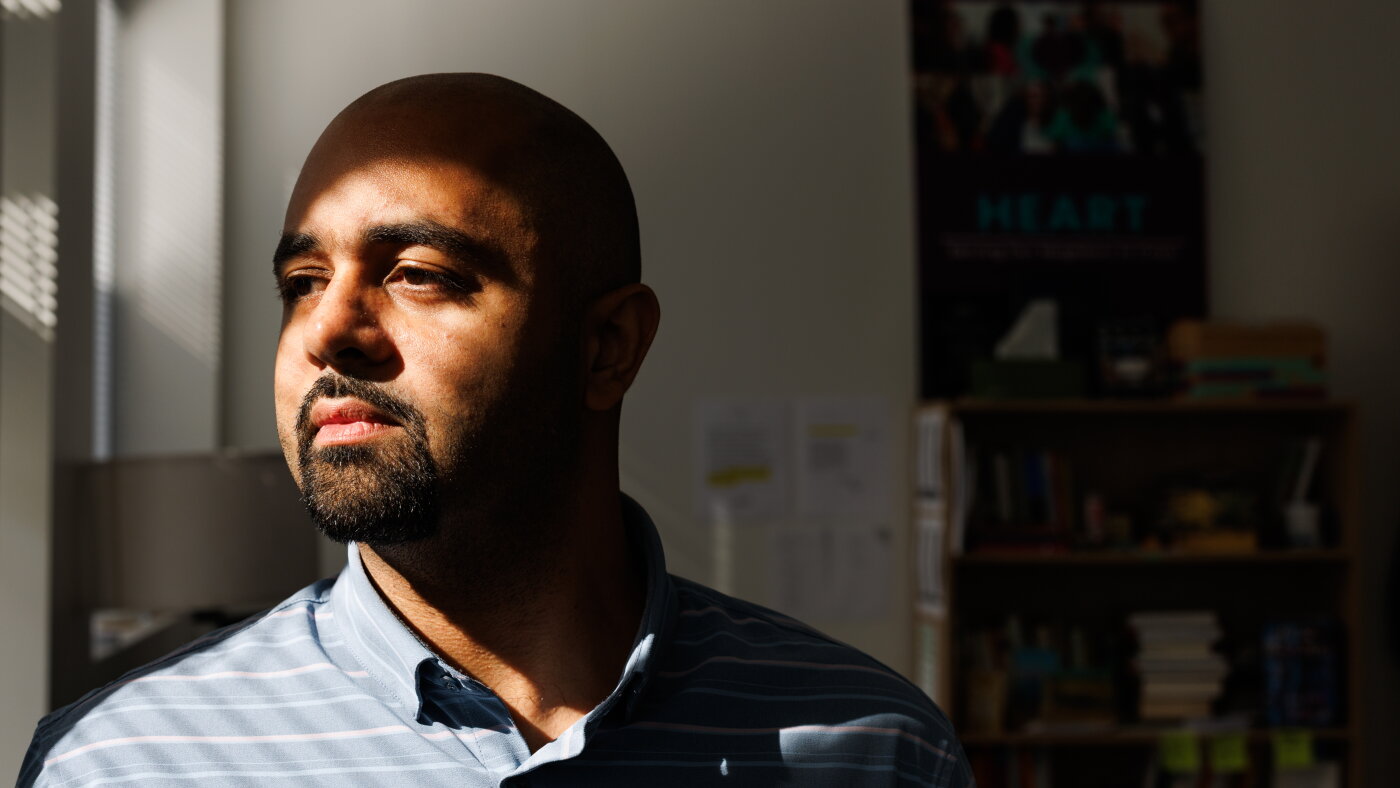
Rob Crisp, a peer support specialist with the Holistic Empathetic Assistance Response Team (HEART) program, responds to a call for a wellness check at a parking lot in Durham, N.C., on Sept.14.
Cornell Watson for NPR hide caption On a recent Wednesday in Durham, N.C., Rob Crisp and Allie Craft were on a mission, equipped with snacks, bottled water and hygiene kits.They are part of Durham's unarmed community response team, and they were looking for a man someone called 911 about."Our notes say we got a trespasser on a business property.
He has a bunch of belongings, and he's refusing to leave," Crisp said.In a parking lot on the side of a strip mall, they found the man, wearing a McDonald's T-shirt and a backward baseball cap and toting several full garbage bags and a sofa with him.Crisp approached the man, who looked tense.
He said he didn't want anyone to touch his things.Crisp, a peer support specialist who has struggled with drug addiction in the past, took his time talking with him."I can relate to not having anything," Crisp later told NPR.After a few minutes, he calmed the man down."I was like, 'We're not trying to bother you, but hey, we do have some supplies while we are here.
Is it all right if we get you a bag together?' Little things like that to say, 'Hey, I don't have a gun.I don't have a badge.
I'm here because I feel for you, brother,'" Crisp said.Crisp and Craft, a mental health clinician, gave the man water and a fresh pair of socks.They convinced him to haul his things off the property and onto a nearby vacant lot.
It was not a long-term solution, but it resolved the immediate conflict.Just five years ago, police would have most likely been dispatched to respond to this 911 call.But since the police killing of George Floyd in 2020, dozens of cities around the United States have made the same calculation: that calls like ...