


Thunder beast or swamp rhino? Fossils of prehistoric animal uncovered at SoCal construction site
This is read by an automated voice.Please report any issues or inconsistencies here.
See more from the L.A.Times in Google Search.
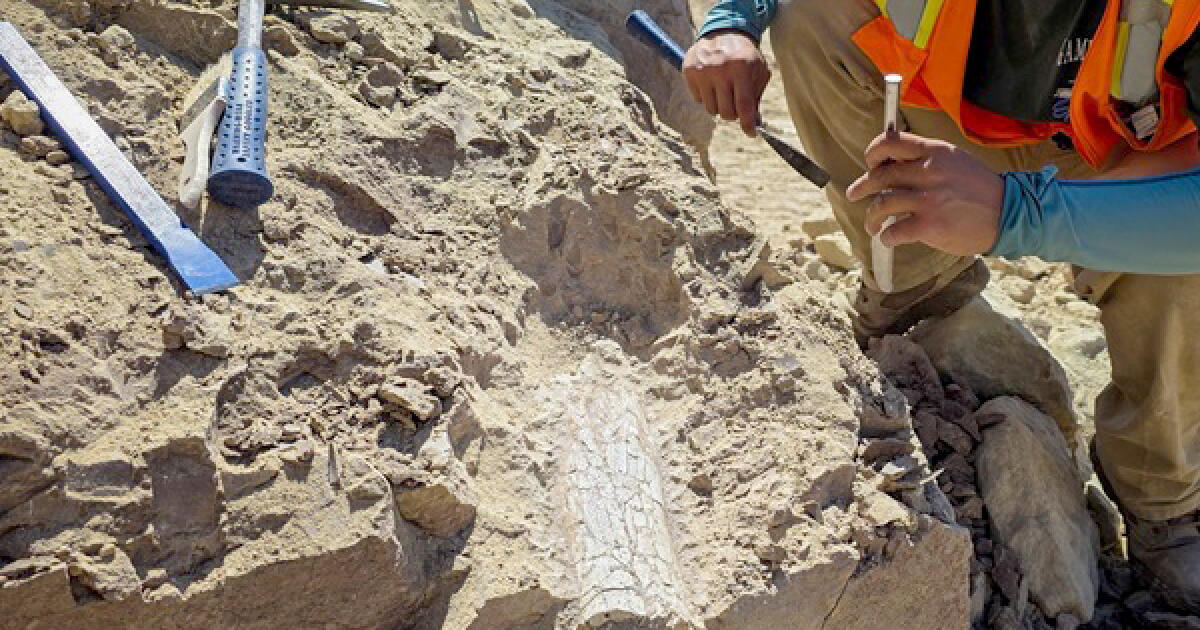
Set us as preferred Southern California work crews were doing some routine excavation recently when they dug up one very strange animal.It could be a “thunder beast” or possibly a “swamp rhino.”What’s clear, according to scientists, is that it was a massive mammal that inhabited what is now Oceanside around 40 million years ago.The fossilized remains of the hoofed mammal were found at a construction site, where crews unearthed several limb bones, ribs and other fragments that likely belonged to a single animal, the city of Oceanside said in a statement Tuesday.Joseph El Adli, consulting paleontologist, spoke with The Times on Wednesday about the find.The fossil bones, the largest of which was more than 2 feet long, were found about 12 feet below the surface during routine excavation for an Oceanside water infrastructure project, said El Adli, whose environmental consulting firm was overseeing the construction site.
Workers were digging in a fossil-rich sedimentary rock unit known as the Santiago Formation.El Adli said the fossils likely belonged to an animal from one of two extinct mammal families that roamed North America during the Uintan North American Land Mammal Age.One possibility is that the animal is a Brontotheriidae, or “thunder beast.” It is a massive, hoofed mammal with a deep chest and pronounced hump at the shoulder.
It could also be an amynodon, or “swamp rhino,” a member of an extinct family of of large-bodied herbivores that are distantly related to rhinos.These semi-aquatic animals had canine teeth instead of a horn and barrel-shaped torsos.El Adli discovered the first fossil fragment on Aug.
31.The excavation process took longer than usual, about 10 days, since the fossils were encased in very hard mudstone under six feet of rock, he said.
Specimens were taken to a lab in Carlsbad for fu...