
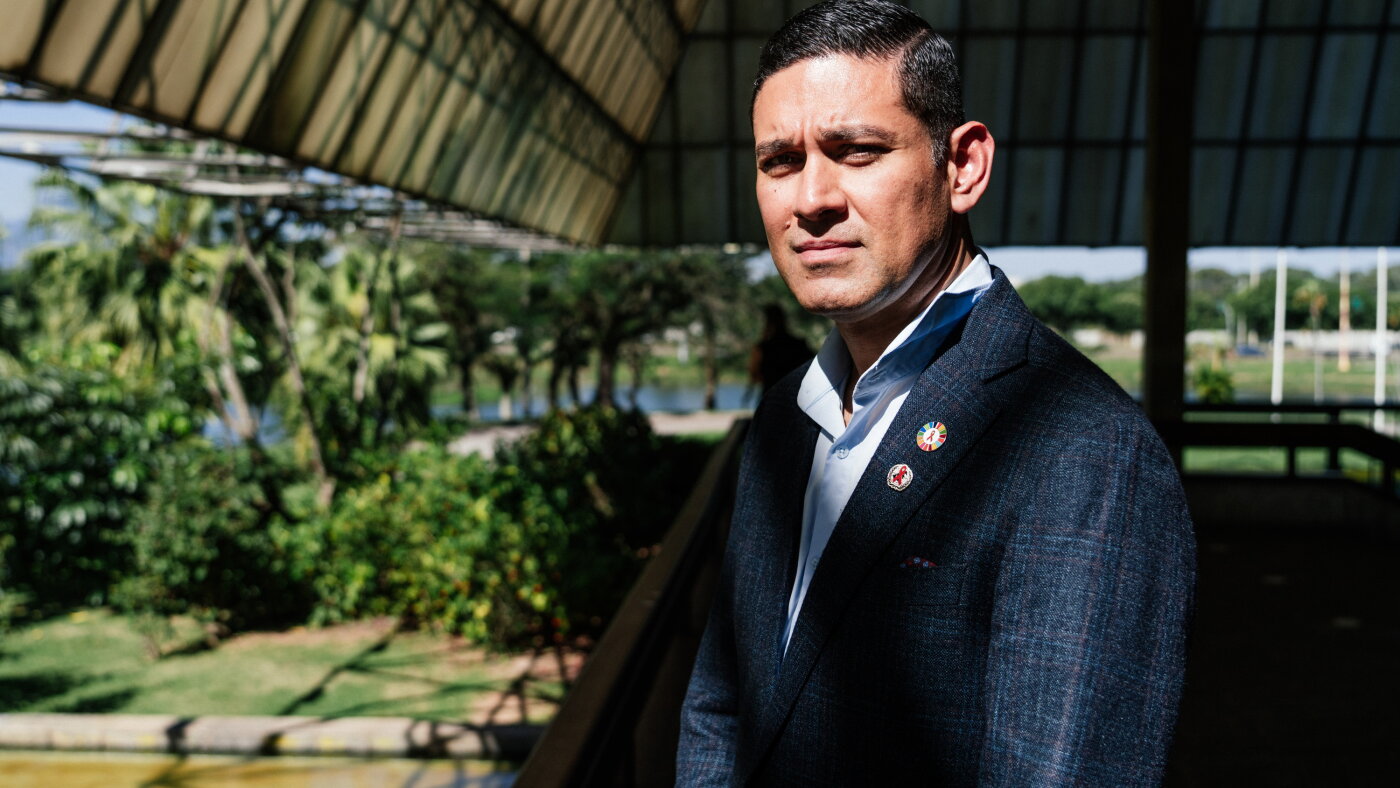
Mark Shaheel Lal is the founder of Living Positive Fiji and a reconciliation officer for the Fiji Truth and Reconciliation Commission.He says: "The majority of my friends, they got HIV through crystal meth." He was photographed at the AIDS conference in Rio de Janeiro, Brazil, in July.
Ian Cheibub for NPR hide caption Best known as a tropical paradise and honeymoon destination, the island nation of Fiji now has the unfortunate distinction of facing two intertwined epidemics: HIV and addiction to crystal meth.With HIV cases rising by 12-fold between 2010 and 2025, in mid-September, Fiji's government declared a national emergency.Estimates are that there are upward of 9,000 cases; the country's health minister has announced that 1 in 60 adults are now living with HIV.At the July AIDS 2026 conference in Rio, Jason Mitchell, a public health specialist leading Fiji's HIV response, described it as the fastest-growing HIV epidemic in the world, noting that two-thirds of cases are in those ages 20-34.
"Our young, active, productive population is currently being infected with HIV, and unless we find solutions quickly, this will continue to get worse," he says.A key cause is another parallel epidemic — the rampant use of crystal meth among the nation's youth, who often inject it.That has led to transmission through shared needles."Two of my best friends passed away," says Mark Lal, a 25-year-old HIV activist from Fiji's capital of Suva.
"The majority of my friends, they got HIV through crystal meth."Crystal meth has long been available to some degree within Fiji — the islands are a known transit hub for the drug between South America and the eventual destinations of Australia and New Zealand.But since COVID, meth use has soared, something Fiji's HIV experts attribute to the lethal combination of rising unemployment and ever more accessible drugs....