


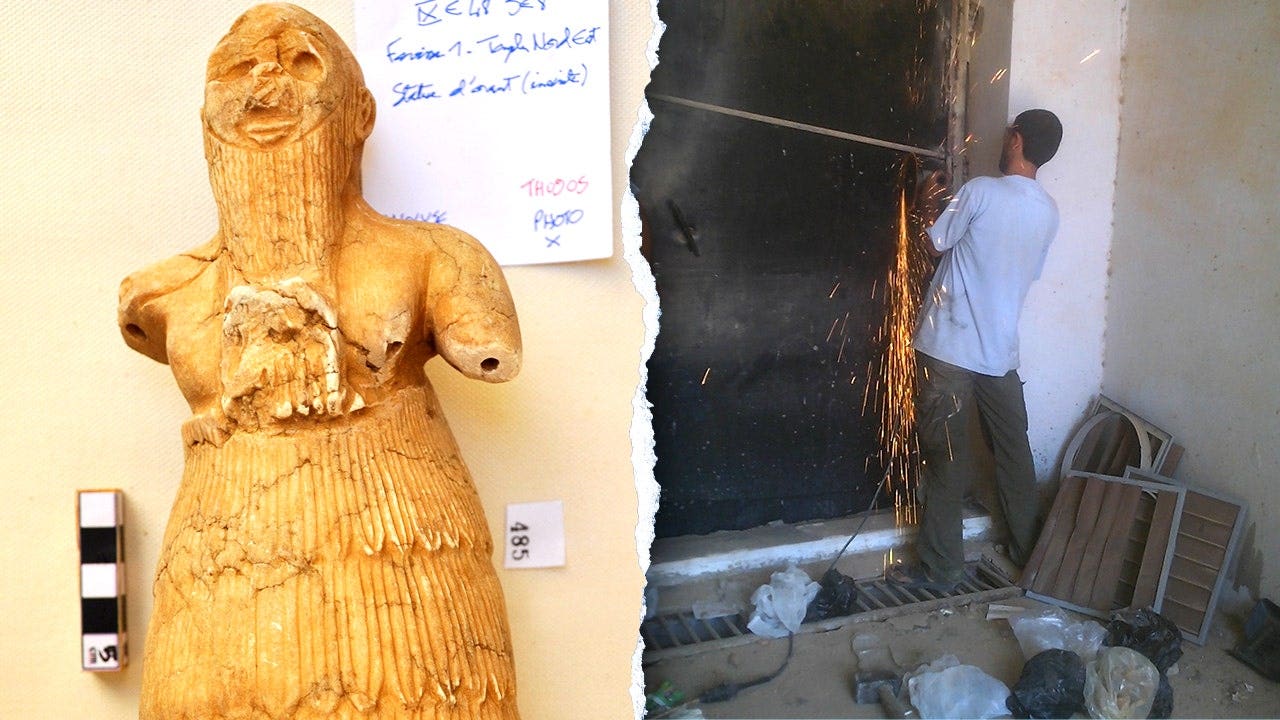
A recent study is shedding light on how brave archaeologists risked their lives to save approximately 30,000 priceless artifacts as ISIS closed in on a Syrian city.Published in the journal Museum Management and Curatorship, the study details the rescue of the artifacts from the Deir ez-Zor Museum in Syria. The artifacts are described as "priceless and were saved from the museum before the city was captured by ISIS," news agency SWNS reported.Phys.org also reported on the study.
ARCHAEOLOGISTS MAKE UNUSUAL FIND NEAR SITE WHERE ARK OF THE COVENANT WAS ONCE KEPTThe Deir ez-Zor haul was part of some 300,000 museum objects rescued and relocated across Syria.The museum's collection spanned thousands of years of history. Archaeologists worked to protect thousands of artifacts as ISIS expanded its control across a region of Syria in 2014.(SWNS)It included ancient statues, jewelry and cuneiform tablets, including numerous tablets unearthed at the ancient city of Mari.Although the rescues took place in 2014 and 2015, new details about the operation have only recently been revealed in the study by Maamoun Abdulkarim, said SWNS. HOLY LAND DISCOVERY REVEALS ANCIENT CHARRED RELICS FROM ONE OF JERUSALEM'S DARKEST CHAPTERSDespite not being one of the largest museums in Syria, the Deir ez-Zor Museum housed one of the country's most valuable collections.The museum held priceless treasures unearthed at some of Mesopotamia's most renowned archaeological sites, including Halaf, Dura-Europos and Mari.The rescue at Deir ez-Zor was part of a broader effort that relocated some 300,000 museum objects across Syria.
(SWNS)Abdulkarim, a professor of archaeology and history at the University of Sharjah in the United Arab Emirates, oversaw the operation as director-general of Syria's Directorate-General of Antiquities and Museums.He presented the rescue as a case study in protecting cultural heritage during wartime.CLICK HERE TO SIGN UP FOR OUR LIFESTYLE NEWSLETTERIn the study, he argued t...