


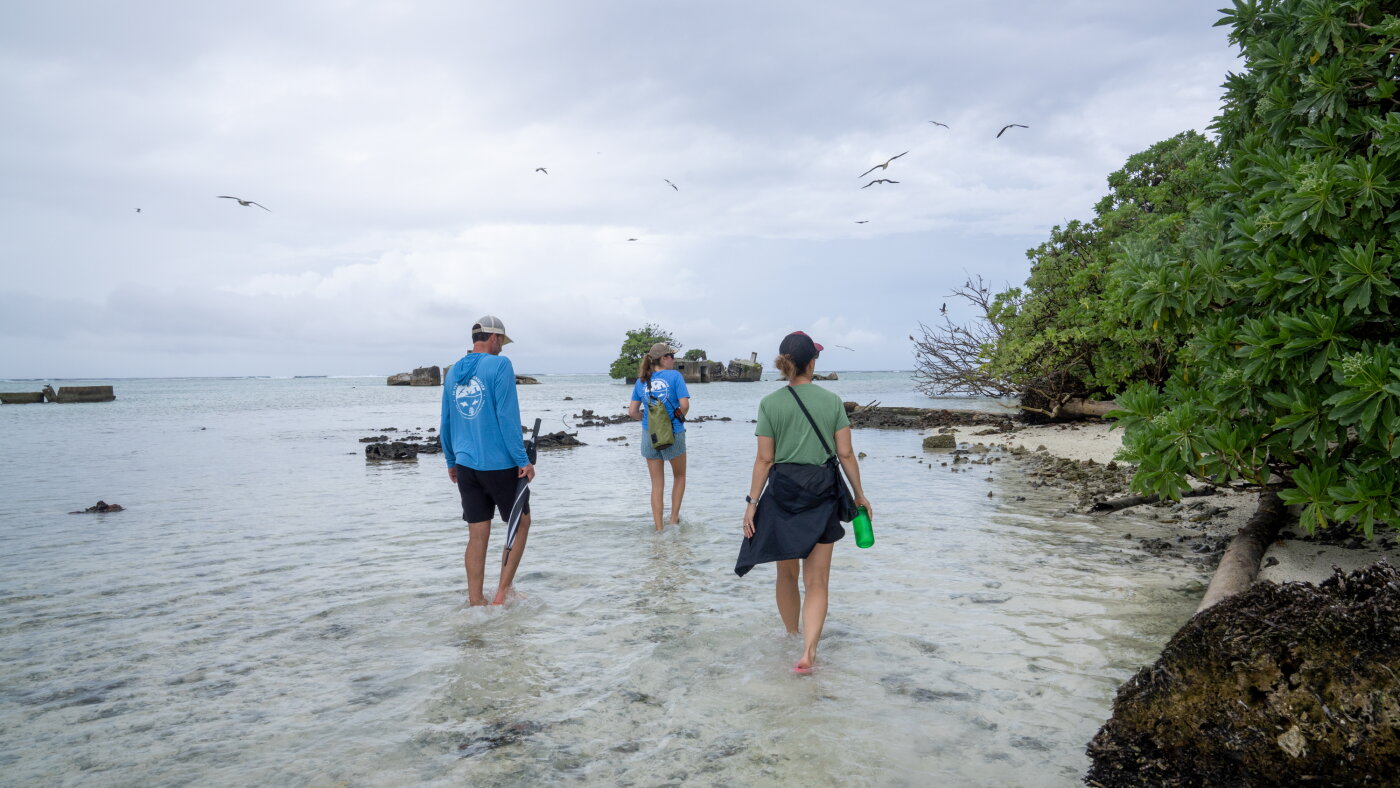
At Palmyra Atoll in the remote Pacific Ocean, wildlife refuge manager Paige Mino observes red-footed boobies.Scientists have found a surprising link between the seabirds and the health of the surrounding ocean.
Claire Harbage/NPR hide caption The remote Pacific Ocean has some of the most pristine coral reefs in the world.The corals themselves are bigger than cars, their delicate arms creating a dense underwater maze.
Above them, the skies are filled with seabirds like red-footed boobies and white terns, searching for fish.These species, separated by land and sea, are far more intertwined than once thought.Their relationship is the backbone of an entire ecosystem — a hidden connection that's changing the way scientists think about conservation.That connection: bird poop.
Coral reefs near seabird colonies are generally healthier, thanks to the nutrients that birds deposit in their guano.It's one reason tropical islands and atolls are biodiversity hot spots in the vast Pacific Ocean.
Joe Pollock of The Nature Conservancy photographs the reefs of Palmyra Atoll, known for being some of the most pristine coral reefs in the world.Claire Harbage/NPR hide caption On some islands, this close-knit partnership has broken down.
Seabird colonies have declined because of habitat loss and invasive species like rats.With fewer birds, fewer nutrients reach the ocean ecosystem.Now, as coral restoration projects work to bring back reefs, they're also focusing on bringing back seabird colonies, reestablishing a connection that helps both species.
Coral reefs are increasingly vulnerable to rising ocean temperatures, and biologists say they need every advantage in a hotter world."If we can figure out ways to just stop the...