


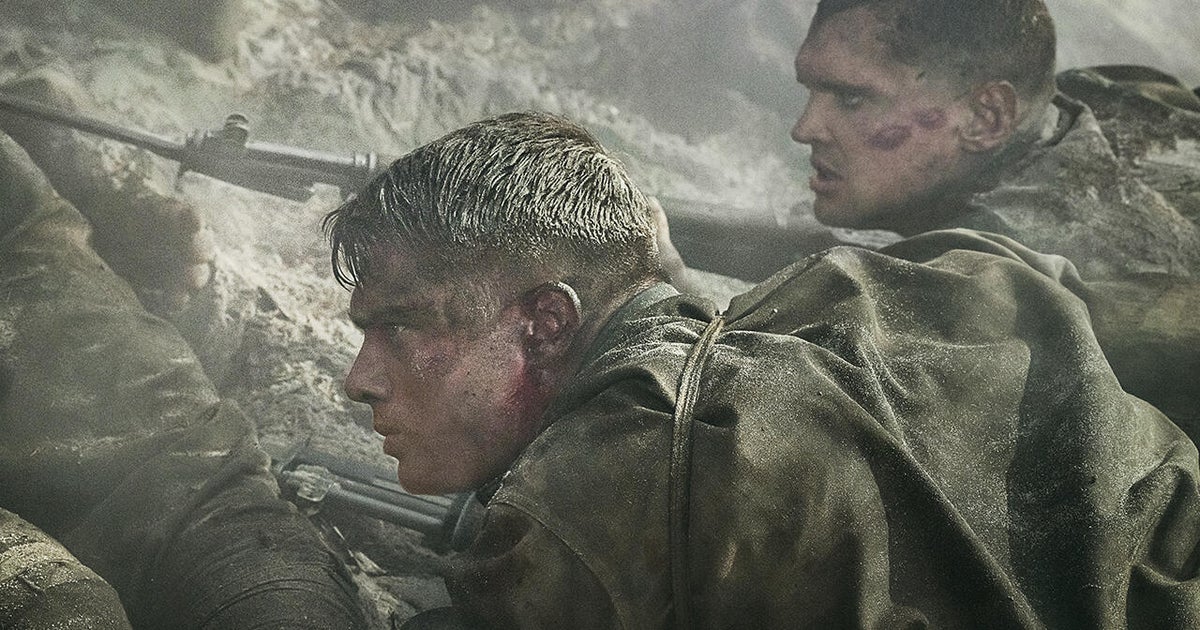
Okinawa proved to be the last and costliest battle of World War II in the Pacific – and it's a name director Peter Berg wants us all to remember.His new movie, "The Mosquito Bowl," captures that battle.
"It is a film that I hope asks us all to look at what we ask of our young men and women," he said."The Mosquito Bowl" is based on the book by Buzz Bissinger, who also wrote "Friday Night Lights," which became Berg's breakout movie.But don't let the title fool you – it's not a movie about a football game.
"No, it's not; it's a movie about the cost of war, the human cost of war," said Berg.The human cost of war as told through the true story of four All-American football players who volunteered for the Marines after Pearl Harbor, and reported to boot camp at Parris Island, South Carolina, which is where we interviewed Berg.
"They came down here and they joined the Marine Corps, thinking, Hey, we'll go win this thing.We'll go whup some butt and win this thing, like we win our football games," Berg said.
"Then they come across an enemy, the Japanese, who are instructed by their emperor, who they believe is a god, to not surrender."They first encountered the Japanese on a tiny speck of coral called Tarawa.When footage of American dead on the beach at Tarawa reached the United States, the public saw for the first time the human cost of war.
It's the first battle sequence in the movie."I wanted it to be as hard and as intense as I could possibly make it," Berg said."I wanted it to feel terrifying, because that's how I believe it was." Berg's immersive style of filmmaking uses real flame throwers and real explosions.
It's also his style of research.For "Friday Night Lights," he spent a season with a high school football team in Texas.
For "Lone Survivor," he spent a month with Navy SEALs in Iraq.He wrote most of the script for "The Mosquito Bowl" on Parris Island."Just gets into your blood," he said.
"And then I carry that, I try to, onto the set.And...