


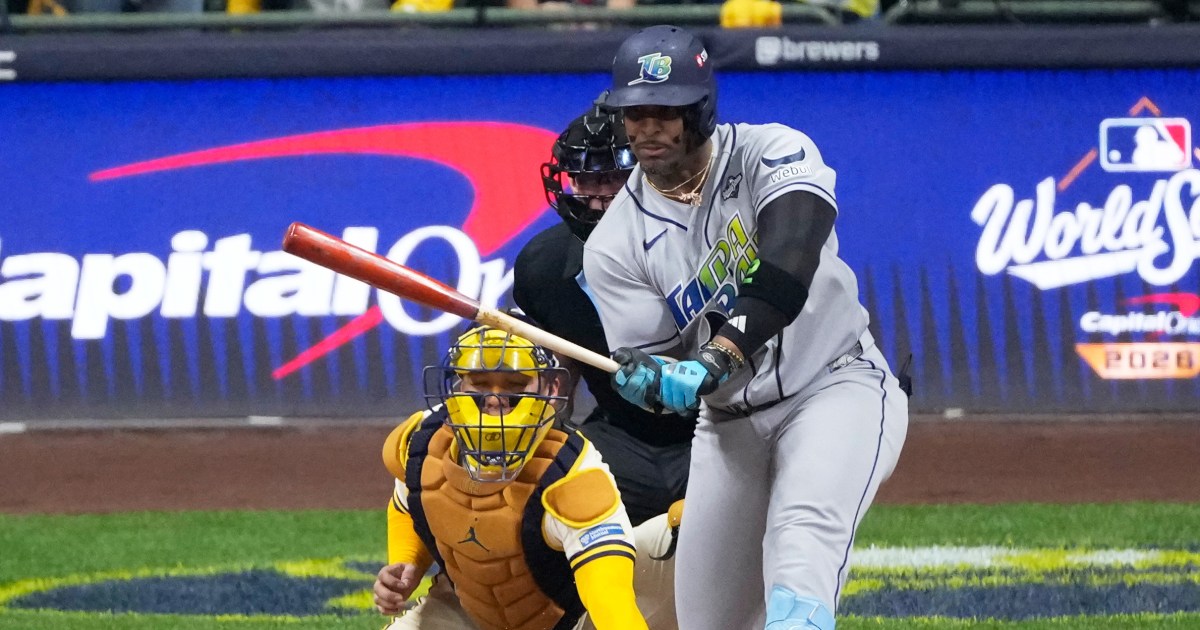
The Milwaukee Brewers are two wins away from the first World Series title in franchise history, and they got a little help from an incredibly close call Saturday night.With the Brewers leading 5-4 in the top of the ninth, the Rays had a runner on third with two outs and designated hitter Yandy Díaz at the plate.On a 3-2 pitch that would have been ball four, Díaz tried to check his swing on a curveball from Aaron Ashby.Home plate umpire Jim Wolf initially ruled that Díaz hadn’t swung, which would have sent him to first base.
But Milwaukee catcher William Contreras appealed to the first base umpire, who ruled that Díaz had gone around.The strikeout ended the game.Here’s how the swing looked in real time:And here’s how it looked on replay: “In the moment, yeah, I disagreed.
But the umpire said it was a swing and it is what it is,” Díaz said after the game.“I didn’t go look at it, but from my vantage point, it did look like that he swung,” Tampa Bay manager Kevin Cash said.The postgame crew on the Fox broadcast seemed split over the swing as well.What exactly is a check swing? It’s a great question, and one that MLB’s rulebook doesn’t answer.According to MLB.com, “there is no definition for ‘check swing’ in the official baseball rules.The closest thing comes in the definition of terms where the first example of a strike is a pitch that ‘is struck at by the batter.’”That leaves it to the umpires’ discretion when a pitch is considered to be “struck at.” Colloquially, a batter has to break an imaginary plane for a check swing to be considered a full one.
What exactly is that plane? Again, there’s no official rule.As with obscenity in Jacobellis v.
Ohio, umpires typically know it when they see it.Why didn’t the Rays challenge the call? Much to the delight of fans, MLB introduced the automated ball-strike (ABS) system this season, allowing players to challenge, as the name suggests, balls and strikes.ABS came on top of t...