


Review: 'The Greatest' deftly captures the evolution of Cassius Clay into Muhammad Ali
This is read by an automated voice.Please report any issues or inconsistencies here.
See more from the L.A.Times in Google Search.
Set us as preferred I pay no attention to boxing.It exists at the corner of my eye in advertisements and feeds, but I’m never tempted to look its way.
Clearly there are plenty of people who do, and plenty of money changes hands in and around it.Neither am I a fan of biopics, though I watch them professionally, which tend to squeeze the nuance out of a life in pursuit of entertainment.But here again, they often prove to be quite popular.
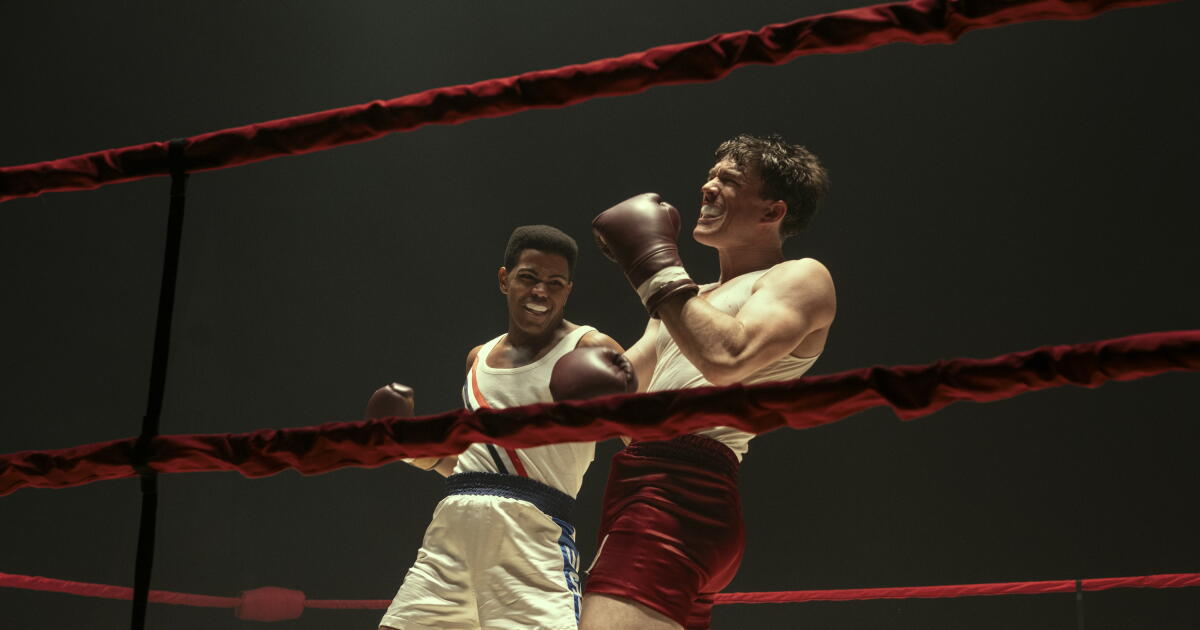
Audiences eat them up.Actors like the “challenge” of inhabiting a person famous enough to be the subject of one, and they often scoop up awards when that season rolls around.Which brings us to “The Greatest,” a series premiering Wednesday on Prime Video, and by “the greatest,” even a person with no affinity for the sweet science, as it’s strangely called, should understand we’re talking about Muhammad Ali, who gave himself the nickname and repeated it until everyone else, on solid evidence, agreed.
(It follows Will Smith‘s 2001 “Ali” and a 1977 oddity, also called “The Greatest,” in which the champ played himself.) Ali, of course, was more than a boxer, he was a phenomenon, globally identifiable like Charlie Chaplin or Mickey Mouse.Even paying no attention to his sport, I seem to know a lot about him, but I would consider much of his life basic cultural knowledge.And it’s very good! Created and partly directed by Ben Watkins (“Cross”), with Ali’s widow Lonnie Ali as an executive producer, it benefits from a relatively short timeline spread out over eight episodes, giving it room to breathe between the set pieces and fights and sundry historical landmarks.
It begins in 1960, after Ali (then, and through the series, called Cassius Clay) has won the light heavyweight gold medal at the Rome Summer Olympics; it finishes in 1964, after — to the surprise and di...