


Farewell, my Smilodon: La Brea Tar Pits to close for two years
This is read by an automated voice.Please report any issues or inconsistencies here.
The back rooms of the La Brea Tar Pits are, at the moment, a maze of packing crates tagged with handwritten sticky notes that say things like “bison skulls” or “camel hip.”Every bone, down to the last dire wolf rib, must be carefully sheathed in a custom foam shell.Sloth jaws and sabertooth fangs and a truly astonishing amount of ancient vertebrae — all of it will be swaddled, catalogued and crated for the next two years.On July 6, the La Brea Tar Pits will close its doors for a massive renovation.
When it reopens in summer 2028, the remodeled Hancock Park museum will be the centerpiece of the Samuel Oschin Global Center for Ice Age Research, a scientific hub dedicated to an era of natural history better preserved here than anywhere else on Earth.The new grounds, which will largely hew to the current building’s footprint, will better show off the museum’s collection and explain how much the ecosystem preserved in the pits can tell us about where our current one is heading.1 2 1.
Bins of labeled fossils.2.
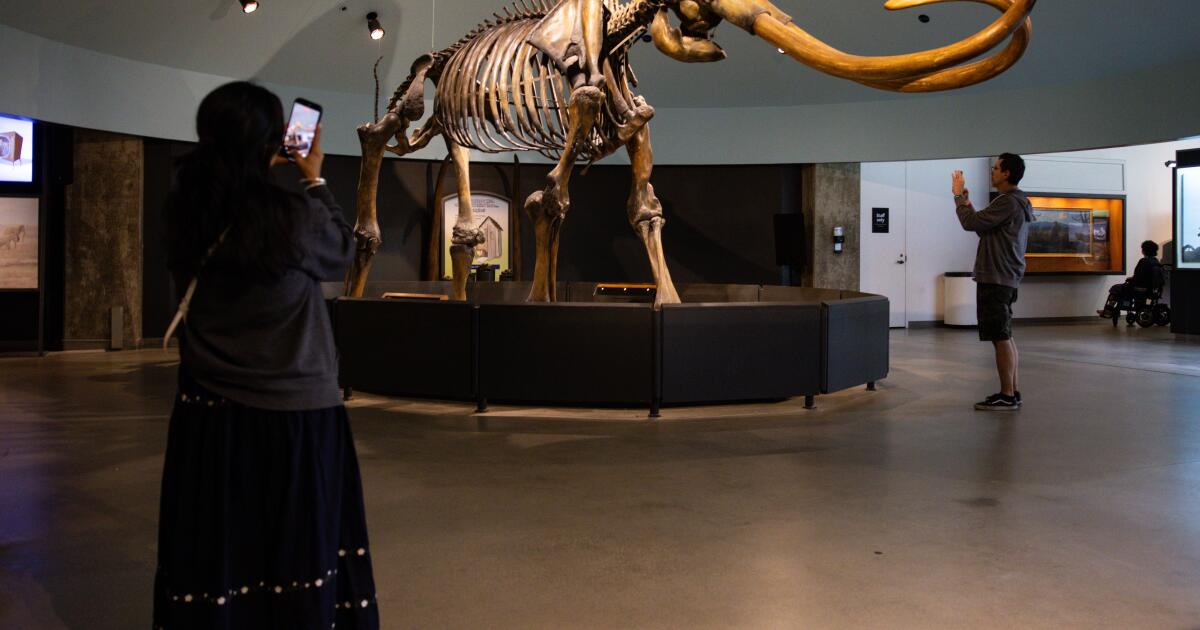
A detail of a Columbian mammoth being restored inside the Fossil Lab.But first, somebody has to pack it all up — all 3.5 million fossils, each fragile and irreplaceable, like a house move out of a nightmare.The same bounty that makes the Tar Pits the best place on Earth to study its slice of the late Pleistocene epoch also makes for a move of truly mammoth proportions.Moving the museum to a different part of Los Angeles is out of the question.
Nature chose its location some 60,000 years ago, when crude petroleum that formed millions of years earlier began seeping to the surface.For the next 49,000 years, the sticky pits captured virtually everything that fell or walked onto them, from grains of pollen borne by the wind to hapless ancient camels and Columbian mammoths.The result is a near-complete record of virtually everything that lived in the place ...