


Enough about her legacy. At 100, Betye Saar just wants to keep making art in L.A.
This is read by an automated voice.Please report any issues or inconsistencies here.
See more from the L.A.Times in Google Search.
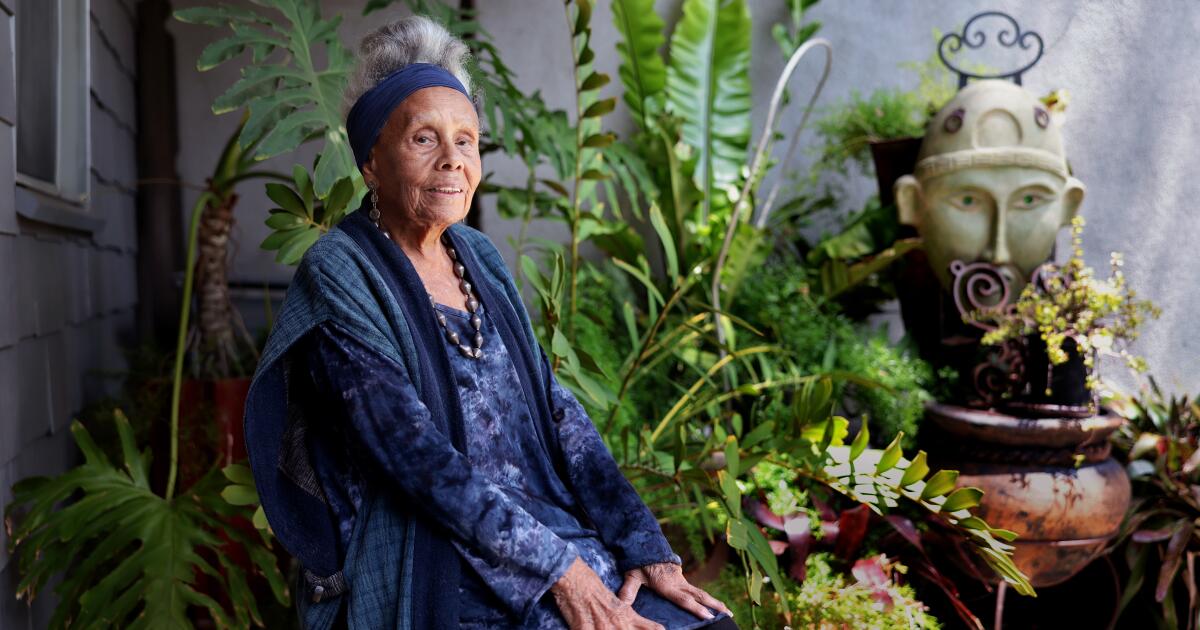
Set us as preferred Betye Saar turns 100 on July 30, but she plans to start her day the same way as always: in the studio.In a small, light-filled room near the top of the Laurel Canyon home where she’s lived since 1962, Saar spends the morning filling sketchbooks with watercolors.Symbols that the pioneering assemblage artist has been “remixing” for more than seven decades — stars, moons, eyes, hands — emerge in vibrant washes of magenta, teal and her favored crepuscular blues.Later, sitting on an aluminum bench in one of her many-tiered patios, she flips between a blank page and another in which a serpent curves across a cerulean plane.
“That’s what art is,” she says, flipping it again.“Making something where there was nothing.” She arranges four painted notebook covers together on her lap, forming a collage.
“See,” she says, “you can use anything.”And she has.Since the late 1960s, Saar has transformed washboards, dolls, clocks, family photographs, racist memorabilia and other salvaged materials into emotionally charged assemblages now held in the permanent collections of more than 60 museums.“There are certain people,” says curator Zoé Whitley, “who redefined what was a very narrow definition of American art, and Betye is absolutely one of them.”Saar’s studio is packed with relics gathered from sidewalks and swap meets in L.A., and from trips to Marrakesh, Mexico, Nigeria, Haiti and Brazil.
Antique globes are mixed with model boats, window panes, wooden masks and painted watermelons.Mercantile scales and rusted bird cages are scattered across crowded shelves.
Neatly labeled drawers hold hand fans, plastic snakes, buttons, buckles.It can be difficult to distinguish where an arrangement ends and an assemblage begins.Materials, like symbols, are recycled across sculptures and tableaux ...