


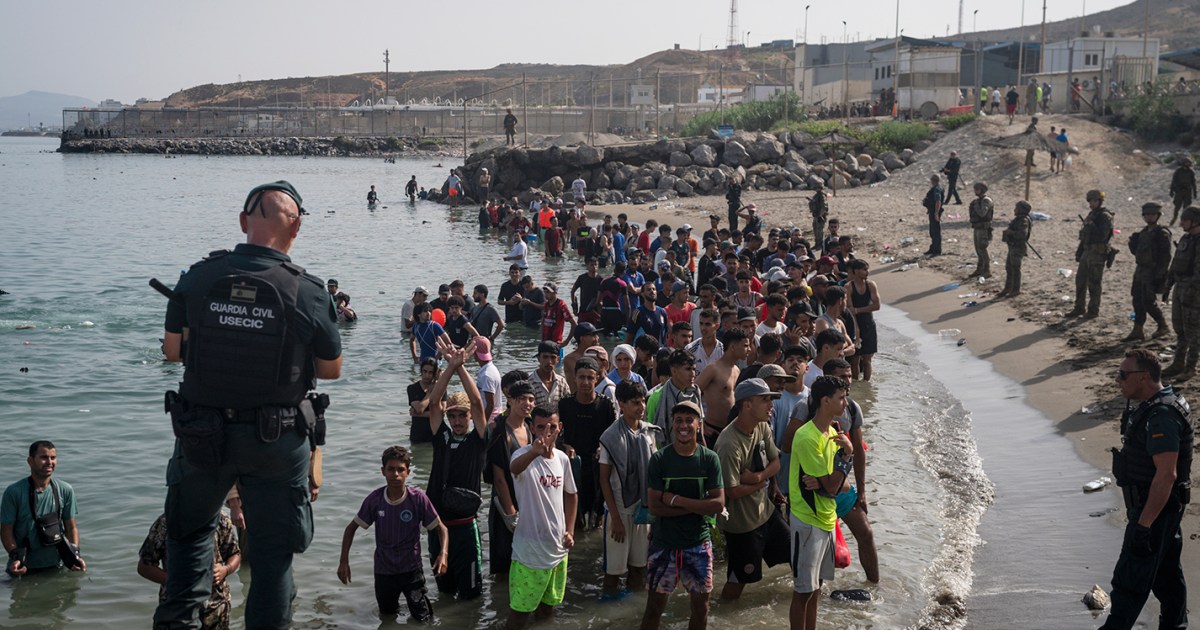
Tens of thousands of migrants crossed from Morocco into Ceuta, an autonomous Spanish territory in North Africa, between July 30 and 31.The unexpected crisis overwhelmed local authorities and infrastructure, marking a first test of the European Union’s (E.U.) new Pact on Migration and Asylum.
The scale and speed of the crossing exposed a real flash point in Europe’s migration system, but how fast authorities regained control has become its own point of contention—over whether the E.U.system is failing or working as designed.
The surge drew criticism from Washington and European capitals.The State Department claimed that the Spanish government had led efforts “to enable and facilitate mass illegal migration into Europe.” Denmark and Italy led a similar critique at the E.U.
level, sending a letter—co-signed by 22 member states—that called for coordinated E.U.border measures and accused Spain of enacting policies that were a “pull factor” for undocumented migrants.
Far-right parties across Europe have seized on the crisis to attack Spain and Europe’s migration policy.Charles A.Kupchan, an expert on European affairs at CFR, explained that the surge came as a shock because migration to the E.U.
is generally “more of a trickle than a deluge” in terms of the number of arrivals.“This rush, this mass of humanity, all coming in the span of forty-eight hours is quite unusual, and it’s because of the size, scope, and speed that it caused such a stir,” he said.
While most migrants have since returned to Morocco, the incident has renewed the debate over European border and migration policy — long a thorny political issue.What happened in Ceuta? Approximately 72,000 migrants crossed into Ceuta from Moroccan territory in just a few days, according to Spain’s interior minister.(Some reports put this figure at between 50,000 and 60,000.) Most migrants reached Ceuta by sea, either by swimming or using makeshift flotation devices.
More than 80 pe...