


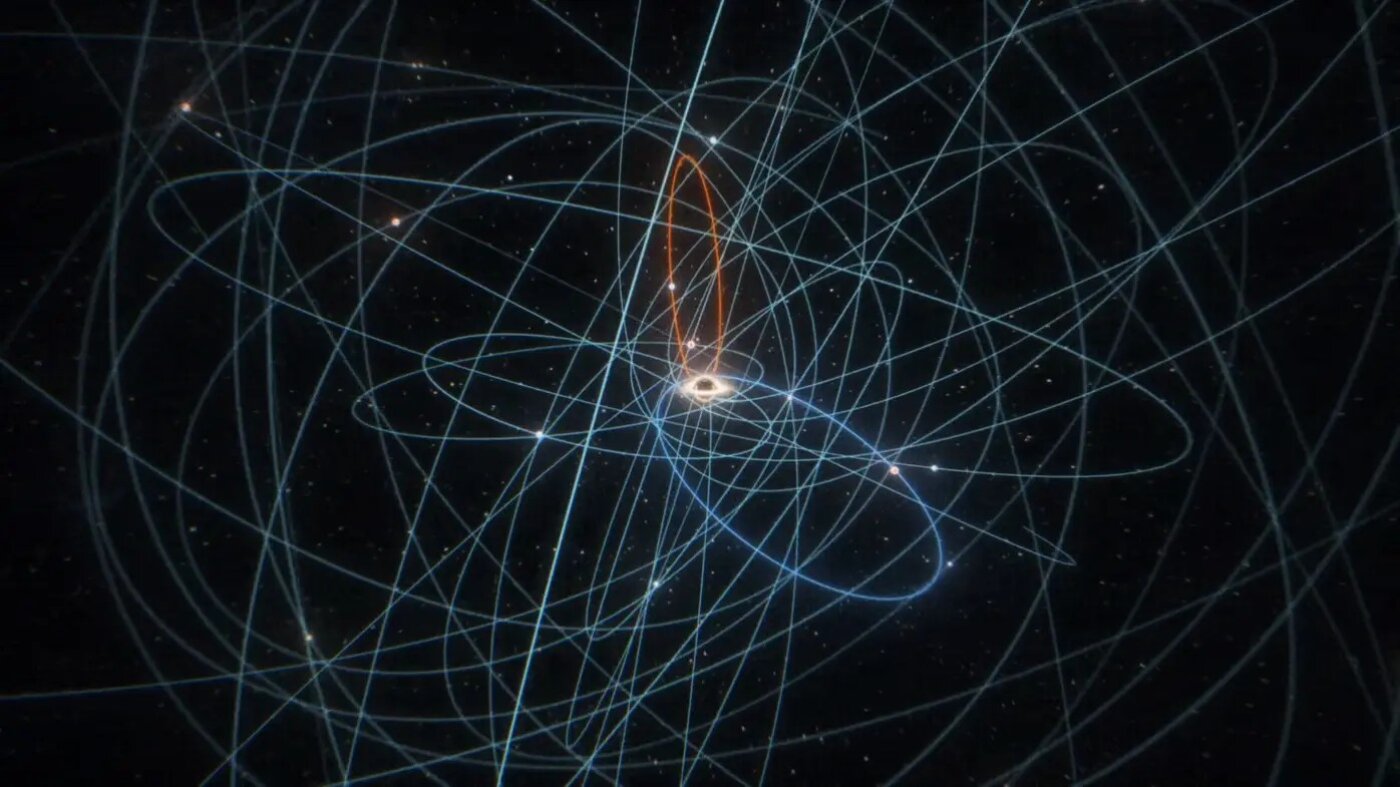
In the fall of 2002, scientists calculated the mass of a truly gargantuan entity at the heart of our Milky Way galaxy.It was four million times the mass of our Sun — so big it almost certainly had to be a supermassive black hole.The object "probably looks like Interstellar," says Stefan Gillessen, an astronomer at the Max Planck Institute for Extraterrestrial Physics in Germany, referring to the 2014 sci-fi film starring Matthew McConaughey and Anne Hathaway.
"You have this dark shadow, this silhouette, where the absolute darkness is" surrounded by a shimmering halo of light.There's a reason that some of our favorite images of black holes come from fiction: In reality, they're very hard to see.Black holes are, by their very nature, yawning enigmas — their gravitational pull is so powerful that not even light can escape — so to learn anything about them is like rescuing information from an abyss.But astronomers may have found a luminary assistant to help them work around that challenge.
In new research published in the journal Nature on Wednesday, Gillessen and his colleagues describe the fastest star ever observed, racing around Sagittarius A*, the black hole at the heart of the Milky Way galaxy.Gillessen says that what's important about the discovery isn't the star's speed — but rather its proximity to the black hole."Thereby we can use the star [as a probe] to visualize how gravity is acting on space and time," he says.Despite their gravitational dominance in the universe, researchers still have rather basic questions about black holes."We want to understand how black holes work and how black holes influence their direct environment," says Gillessen, including the fundamental role that they play in helping shape their home galaxies."And if you want to know about black holes," he adds, "the center of the Milky Way is the best laboratory we have.
It's right in front of our doorstep."Gillessen and his team used four of the European Southern Observatory's t...