


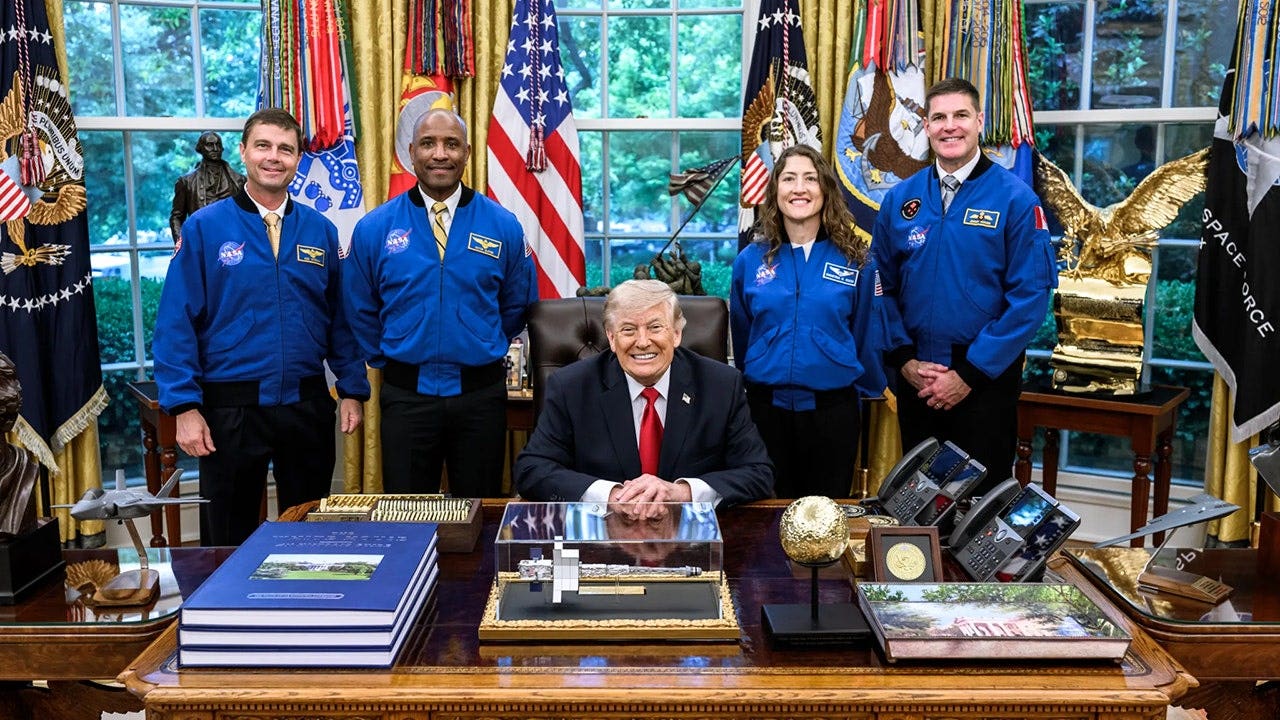
President Donald Trump is set to honor four astronauts who traveled farther from Earth than any humans in history during a record-breaking journey around the moon earlier this year.Trump will award the Congressional Space Medal of Honor to NASA astronauts Reid Wiseman, Victor Glover and Christina Koch and Canadian Space Agency astronaut Jeremy Hansen during an Aug.28 ceremony at NASA's Johnson Space Center in Houston, the agency announced.The four made history in April aboard Artemis II, the first crewed flight of NASA's Orion spacecraft and the first mission to take astronauts around the moon in more than half a century.PETER NAVARRO: TRUMP'S ARTEMIS VISION IS NOW FLYING — AND CHINA IS PAYING ATTENTIONArtemis II crew NASA astronauts Reid Wiseman, left, Victor Glover, Christina Koch, and CSA (Canadian Space Agency) astronaut Jeremy Hansen in the White House Oval Office with President Donald Trump.
(White House via NASA)At their farthest point, the crew traveled 252,756 miles from Earth, surpassing the human spaceflight distance record set by Apollo 13 in 1970, according to NASA.The astronauts covered 695,081 miles during their nearly 10-day mission.Their voyage began April 1, when NASA's Space Launch System rocket lifted off from Kennedy Space Center in Florida with 8.8 million pounds of thrust.
After testing Orion's systems in space, the crew headed toward the moon and passed within 4,067 miles of the lunar surface during an April 6 flyby, NASA said.NEW ARTEMIS II VIDEO SHOWS MOMENT NAVY MEDICAL TEAM OPENED HATCH, WELCOMED ASTRONAUTSThe Artemis II crew, Commander Reid Wiseman, left, mission specialist Christina Koch, pilot Victor Glover and Canadian astronaut and mission specialist Jeremy Hansen as they answer media questions during a video conference, April 8.(NASA via AP)The astronauts captured more than 7,000 images along the way, including views of earthrise and earthset, lunar craters, ancient lava flows and a solar eclipse seen from Orion.
NASA said the ...