


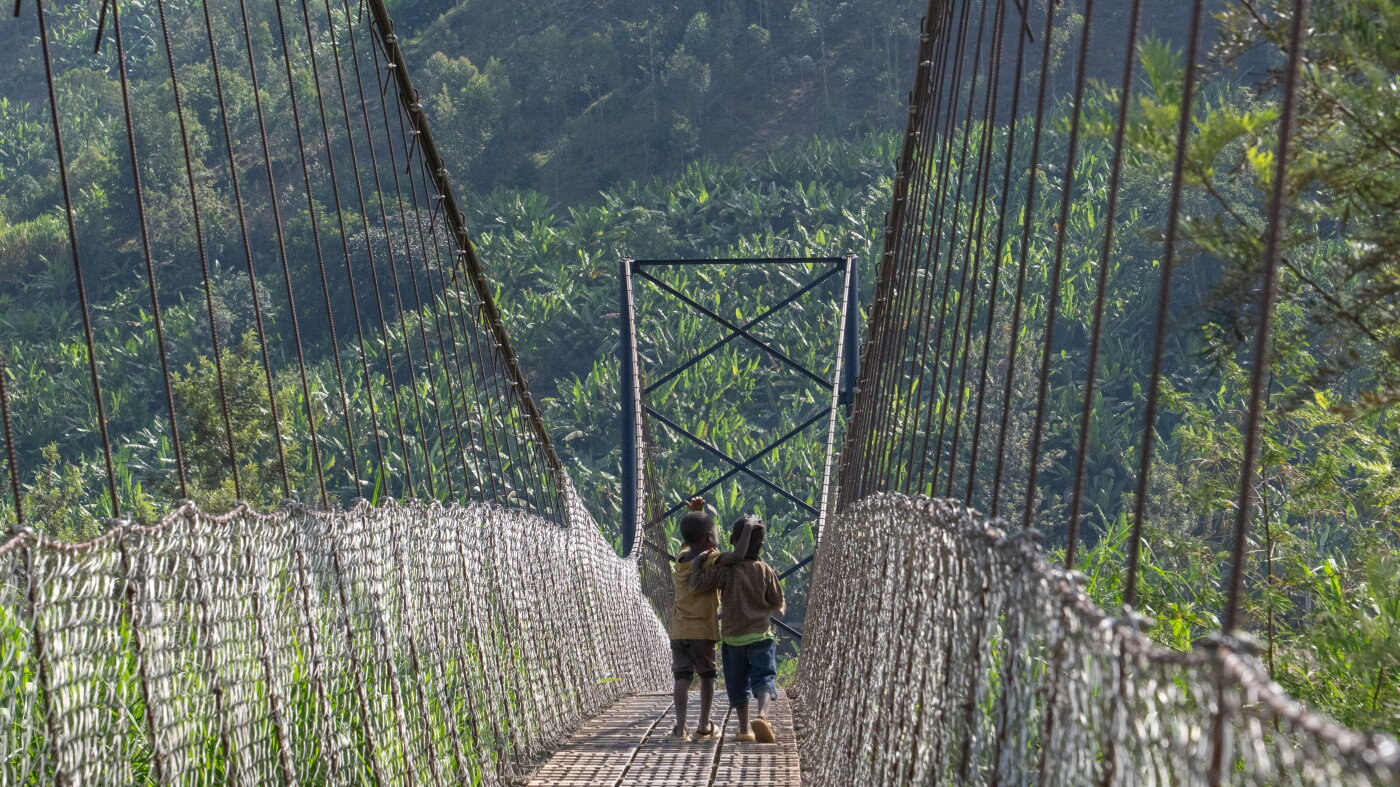
Naomi Nibishaka crosses the newly constructed pedestrian bridge over a river.She's on her way to see her son and grandchildren, who live in a settlement on the other side.
Claire Harbage/NPR hide caption MUKUNGA RIVER VALLEY, Rwanda — For Naomi Nibishaka, there's life before the bridge, and life after the bridge.On a sunny summer day, the 76-year-old crosses the rushing waters of the Mukungwa river on a pedestrian suspension bridge.Made of concrete and cable, it's only 230 feet long — roughly the length of a city block.But it's a game changer.The bridge connects two settlements in a valley in northwest Rwanda that are separated by the river.
People cross for all sorts of reasons.Certain services are only available on one side –- a health clinic, a school, a market.
Farmers may cross to seek supplies or sell their harvest.Nibishaka is on her way to see her son and grandchildren, who live across the river from her settlement.Before the bridge was built, there were crossing options — none of them great.
You could hire a boat but it was expensive.Local authorities would rope together timber logs for a makeshift bridge, but in the rainy season, the logs would grow slippery and floods would wash them away.
In the past, communities separated by a river would build a makeshift bridge of logs.But spring rains would make them slippery and sometimes wash them away.
Claire Harbage/NPR hide caption The other alternative was hiking to a narrower crossing — but that took 3 hours each way."When someone [who attempted the crossing] went missing, we would look for them, but if it was a rainy day, we would ask the other side if that person slept over," Nibishaka says."And if they can't find them, we would loo...