


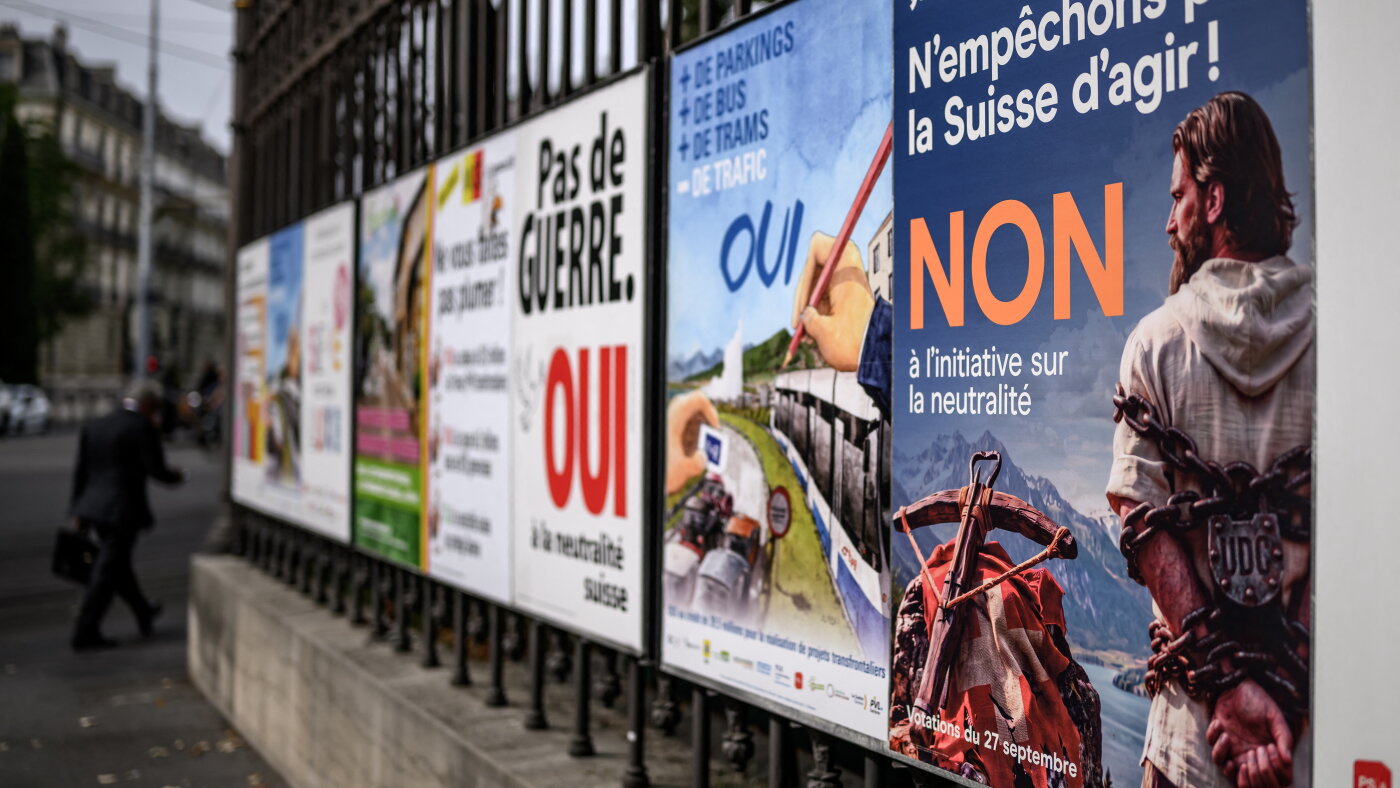
BERN, Switzerland — The people of Switzerland are voting this weekend on whether to reinterpret their long tradition of neutrality.For more than 200 years, the Swiss have stayed out of wars.
Their neutral status was originally imposed on them by the big 19th-century European powers; France on one side, and the Austro-Hungarian Empire on the other - which wanted a buffer zone between them.So, although not of their own choosing, neutrality allowed Switzerland to avoid the slaughter of two world wars, and, in later years, to use its neutral status to justify continuing its trade with repressive regimes, such as apartheid South Africa, that other governments had sanctioned.That changed in 2022 when Russia invaded Ukraine.After a few days' hesitation, Switzerland, which is not a member of the European Union, joined the EU's sanctions against Moscow, stopping trade, and freezing billions of dollars in Russian assets.The move was welcomed by many younger Swiss.
As its government agonised over how to react, Switzerland's cities had seen days of protests calling for solidarity with Ukraine.But traditionalists were angry at what they saw as a weakening of neutrality.They collected the required signatures to force this weekend's nationwide vote, which would explicitly forbid Switzerland from joining economic sanctions unless they are approved by the UN Security Council – an unlikely prospect nowadays since the five permanent members (the U.S., China, Russia, France and the United Kingdom) agree on very little.The proposal would enshrine neutrality in Switzerland's constitution, block the Swiss from joining military alliances like NATO, and define neutrality as permanent armed defence of Swiss territory only.The campaign is led by the grand old man of the right-wing Swiss People's Party, 85-year-old Christoph Blocher.
He has spent decades campaigning to keep Switzerland out of the European Union and even opposed the country's membership in the United Nations, which Switz...