


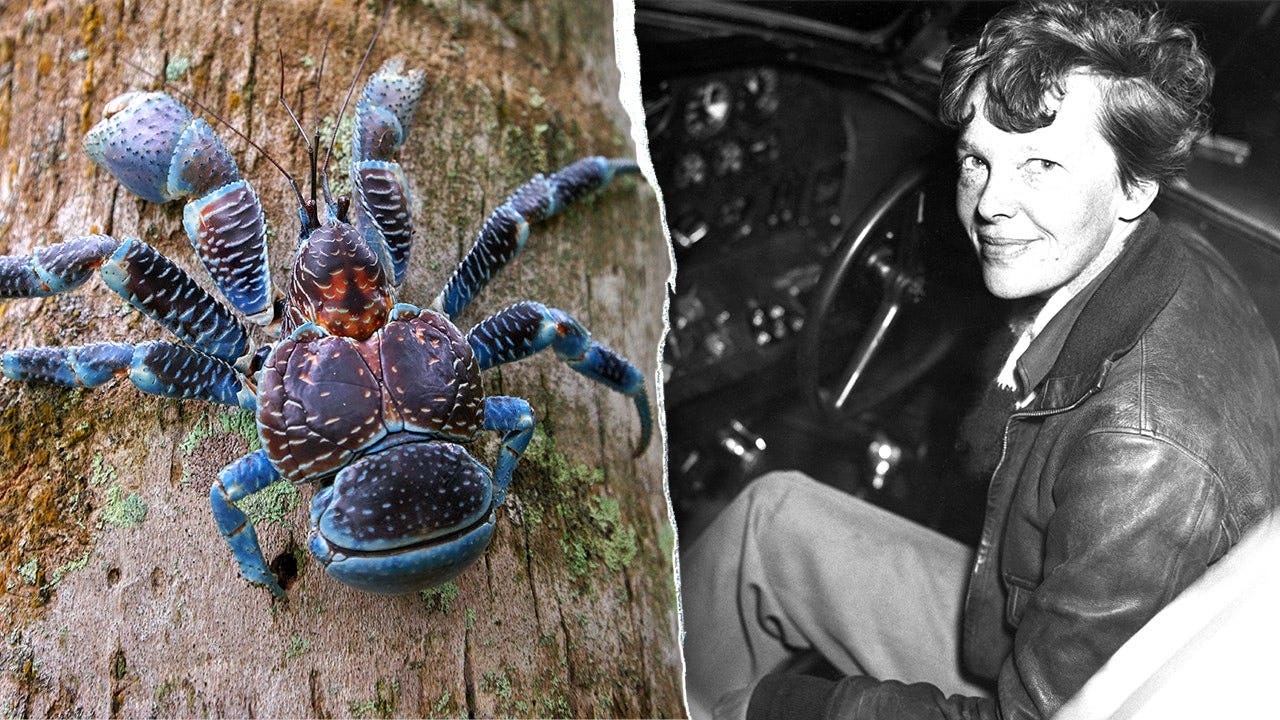
Massive meat-eating coconut crabs are posing an unusual challenge for the team searching for Amelia Earhart's missing plane on the remote Pacific island of Nikumaroro.Purdue University confirmed on Monday that the crew would sleep aboard its vessel rather than on the island, citing the enormous crustaceans as one reason for the decision.The 17-person expedition team arrived off Nikumaroro on Monday evening after a five-day voyage across the Pacific, going ashore the following morning to begin investigating clues that could help solve Earhart's disappearance.AMELIA EARHART MYSTERY ENTERS CRITICAL PHASE AS EXPLORERS ZERO IN ON MYSTERIOUS OBJECT"The crew will sleep nightly aboard the Marin Mainiku for a number of reasons, one of which is the presence of coconut crabs, whose size and overnight activity make staying on the island impractical," the university said.The team, which is 16 hours ahead of Eastern Daylight Time (EDT), has already encountered the massive crustaceans while working on the island.Massive coconut crabs are posing an unusual challenge for those searching for the missing aircraft of Amelia Earhart, shown at right, on the remote Pacific island of Nikumaroro.(iStock; Bettmann via Getty Images)In a Tuesday statement, Purdue University officials said researchers came across at least four coconut crabs while clearing an overgrown trail to the island's lagoon.The path, nicknamed the "Gallagher Highway," had become heavily overgrown since the last expedition — forcing researchers and crew members to use machetes and hand chainsaws to clear a route.The work took about two hours.
Despite the crab encounters, the animals "posed no threat to the operation," according to the university.DIVERS BRAVE DEADLY 'MOUNT EVEREST OF SHIPWRECKS' AS FAMED WRECK BREAKS APARTThe coconut crab is considered the largest terrestrial arthropod, according to a 2011 report from the U.S.Geological Survey (USGS).The crab digs shallow burrows for mating and molting and frequently ma...