


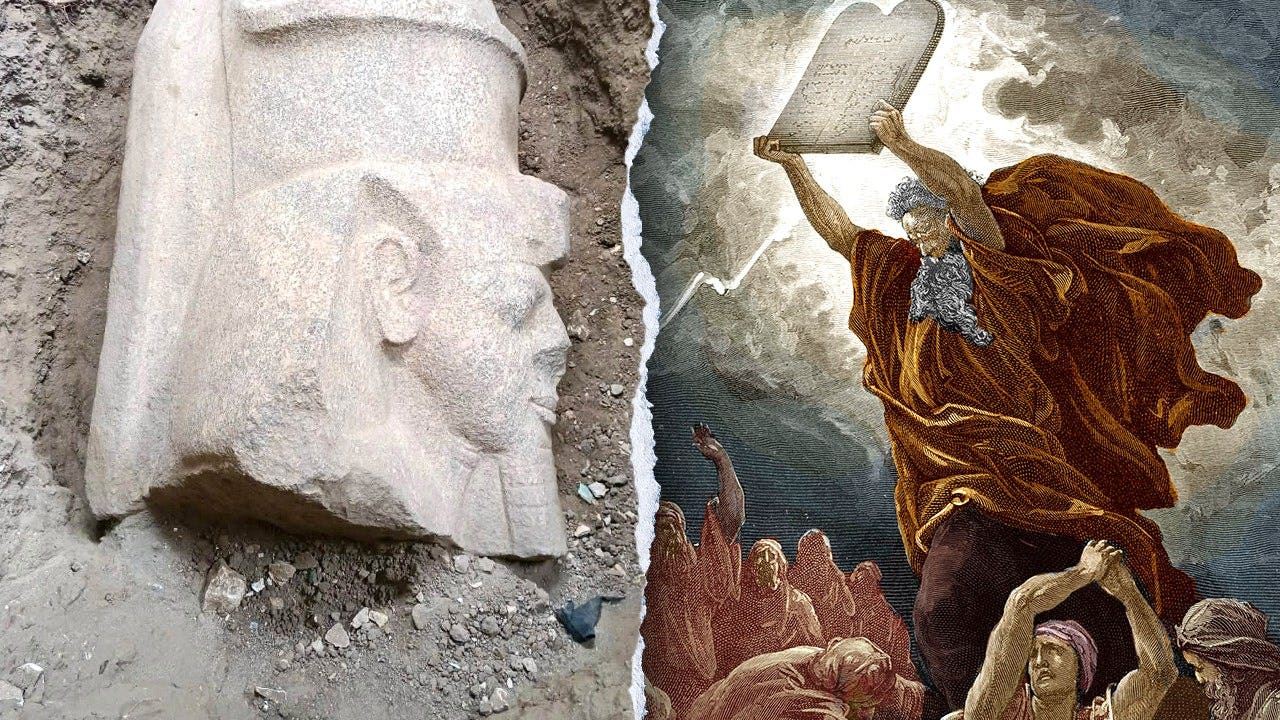
An Egyptian farmer tending to his cucumbers stumbled upon an ancient stone that led archaeologists to a much bigger discovery.They found the remains of two colossal statues believed to depict Ramses II, the pharaoh some scholars believe may have confronted Moses in the biblical Book of Exodus.The finds were announced by the Egyptian Ministry of Tourism and Antiquities earlier this month. ANCIENT EGYPTIAN SETTLEMENT DISCOVERED FROM ERA THAT FUELED EXODUS DEBATEThe farmer found the inscribed stone while working in a cucumber greenhouse on his property in the village of Behbeit El-Hagar, according to Egyptian news outlet Youm7.The man then alerted local archaeological authorities, who inspected the site and uncovered the remains of two statues during subsequent excavations, ministry officials said. "One of the statues has been identified as depicting King Ramses II, while the other is also believed to represent the same pharaoh," the translated statement read.An Egyptian farmer's discovery of an inscribed stone led archaeologists to two massive statues believed to depict Ramses II — seen at right.Some scholars associate him with Moses, depicted at left, and the biblical Exodus.
(Fine Art Images/Heritage Images/Getty Images; Egyptian Ministry of Tourism and Antiquities)"The mission additionally discovered a pink granite block bearing hieroglyphic inscriptions that include several of the king's royal titles."Ramses II, who was born in 1303 B.C., was among the most powerful and influential pharaohs of Ancient Egypt's New Kingdom period.ARCHAEOLOGISTS UNEARTH ANCIENT TREASURE CACHE AT BIBLICAL CITY CONNECTED TO GENESISSome scholars have suggested that Ramses II was the pharaoh described in the Book of Exodus, although the Old Testament does not identify the ruler by name.In the biblical account, the pharaoh refuses Moses' demands to free the Israelites, leading to a series of devastating plagues.Ramses II died in 1213 B.C.An Egyptian farmer's discovery of an inscribe...